An Open Letter from Steve Jobs to Tim Cook

Time passes quickly and the WiFi is spotty here in Trāyastriṃśaso I apologize for taking so long to check out how you’ve been doing with our company.

Of course, truth be known, Apple was already on that trajectory when I handed you the company, but props anyway.

Beyond that, though, I feel I must ask: Is that ALL you could manage with that money and talent? Seriously?

OK… Let me calm down… Deep breath… Nam Myoho Renge Kyo… Nam Myoho Renge Kyo.. That’s better.

Look, Tim, I don’t want to go all heavy on your case, but here’s what you need to do to make Apple great again:

1. Invest in new technology.

You let our cash on hand get all the way up to $245 billion??? Earning maybe 3% interest? Are you out of your mind?!?!  With those deep pockets, we should be making huge investments and acquisitions in every technology that will comprise the world of the future. You’ve let that upstart Musk make us look like IBM. That’s just plain wrong. 

2. Attack and cripple Google.

Google is our new nemesis, remember? They attacked our core business model with that Android PoC. But, Tim, c’mon… Google is weak. They can’t innovate worth beans and most of their revenue still comes from online ads, which are only valuable because they constantly violate user privacy. You could cut their revenues in half if you added a defaul 100% secure Internet search app to iOS and Mac OS. Spend a few billion and make it faster and better than Google’s ad-laden wide-open nightmare. This isn’t brain surgery.

3. Make the iPad into a PC killer.

WTF? The iPad was supposed to be our big revenge on Microsoft for almost putting us out of business. All it needed was a mouse and could have killed–killed!–laptop sales. Sure, it would have cut into MacBook sales, but that’s the way our industry works. I let the Macintosh kill the Lisa, remember? And the Lisa was my personal pet project. The iPad could have been the next PC… and it still might not be too late.  

4. Give our engineers private offices.

I get it, Tim. You’re not a programmer. You built your career in high tech but it was always in sales and marketing, which are the parts of the business where a lot of talking and socializing make sense. But if you’d ever designed a product, or actually written code, you’d know engineering requires concentration without distractions. Programmers and designers don’t belong in an open plan office. Give them back their private offices before it’s too late.

5. Don’t announce trivial dreck.

A credit card? Seriously? Airbuds with ear-clips? A me-too news service? Is that best you can do? And what was with Oprah And Spielberg at the event? Hey, the year 2007 called and wants its celebrities back. Look, when you gin up the press and the public up for a huge announcement and it’s just meh tweaks to existing products or me-too stuff, it makes us look lame and out of touch. If we don’t have anything world-shaking, don’t have an announcement!

6. Stop pretending we’re cutting edge.

There was a time–I remember it well–when people would line up for hours just to be the first to get our innovative new products. Heck, we even had “evangelists” who promoted our products to our true-believers. But that’s history. Until we come out insanely great new products that inspire that kind of loyalty, dial down the fake enthusiasm. 

7. Make Macs faster, better, cheaper–more quickly.

I’m honestly embarrassed what you’ve done with the Mac. You’ve not released a new design in years. Sure, MacBooks were cool back in the day, but now they’re just average. And where’s our answer to the Surface? Tim, you actually let Microsoft–Microsoft again!–pace us with a mobile product. That’s freakin’ pitiful.

8. Diversify our supply chain out of Asia.

Tim, Tim, Tim…  I love Asia, but you’ve bet our entire company on the belief that there will never be another war (shooting or trade) there. Meanwhile, China has become more aggressive and there’s a madman with nuclear weapons perched a few miles from our main supplier for iPhone parts. Wake up! We need to sourcing our parts in geographical areas where war is less likely.

9. Fix our software, already.

This was the one that surprised me the most. I knew that iTunes, iBooks, Music, and AppStore was a crazyquilt but I figured we could fix that in a future release. But here we are, ten years later, and we’re still asking people to suffer through this counter-intuitive bullsh*t? And what’s with the recent instability with our operating systems? And that wack Facetime security hole? 

10. Make some key management changes.

Delete your account.

Beatifically,

AT&T: Fool's Gold?

AT&T (T) management appears to have finally got the message on debt. The stock has finally rallied to multi-month highs over $32 as the CEO and CFO have remained steadfastly committed to paying down debt. The company continues making questionable moves changing over the leadership at WarnerMedia discussed in my previous article, but the stock has a clear path to $40 with a singular focus on reducing debt levels.

Clear Message

Randall Stephenson became the CEO and president of AT&T on May 9, 2007. During his tenure as the leader of the wireless and media giant, he has dramatically grown debt levels faster than revenues.

In the course of his dozen years at the helm, net debt grew to $180 billion at the peak and ended 2018 down at $171 billion. In all fairness, revenues are expected to hit $183 billion this year with a full year’s worth of WarnerMedia results.

Chart

Data by YCharts

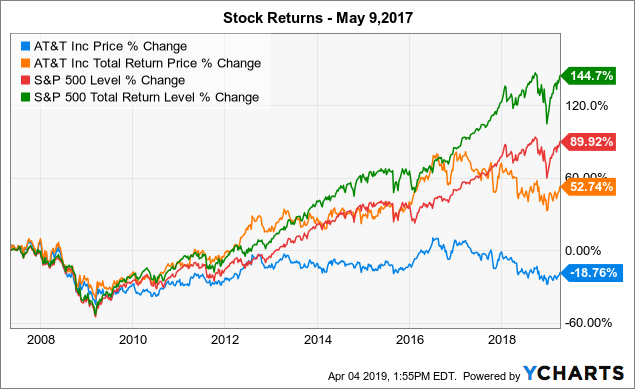
A big key to the story is the stock returns over this period. AT&T shareholders have watched the stock lose nearly 19% of its value during the tenure of CEO Randall Stephenson. The S&P 500 has gained nearly 90% during the period despite the financial crisis shortly after he took over as CEO.

Chart

Data by YCharts

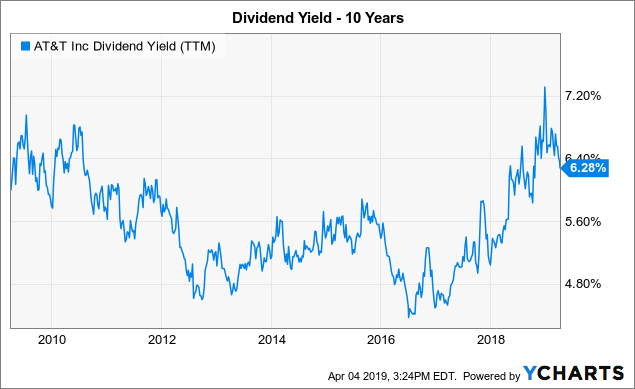
Now a lot of investors like to brag about substantial dividends due to the now 6.4% dividend yield. Clearly though, investors would’ve made far more money just owning the S&P 500 index. Over the course of this period, the S&P 500 index total return is up ~145% versus the total return of AT&T of only ~53%.

Anybody just looking at dividends is convinced they are making a great investment. Anybody buying the stock at nearly $40 when Stephenson took over the helm should be highly disappointed with the overall results.

Using the example of somebody buying $1 million worth of shares back in May 2007 at $40, the investor would have 25,000 shares. Those shares would now be worth only $800,000 with the stock down at $32.

An investor not paying attention to the details probably hasn’t realized that the capital position has lost so much money because the drip has only averaged about $16,666 each year or less than 1.7% of the initial value on an annual basis.

Where the investor gets excited is the dividend payout of $2.04 per year now pays the investor $51,000 annually and the company raises the dividend each year. The problem with the equation is that the shareholder would have an investment worth $2.45 million by just leaving it in an index fund and eliminating the single stock risk that has crushed investors in General Electric (GE) and countless other stocks in the past.

In essence, the dividends are fool’s gold. If an investor now swapped the S&P 500 index position worth $2.45 million for AT&T, that investor would now receive ~$157,000 in annual dividends.

Focus On Debt

For now, the management team appears to have finally got the message. Each and every time the CEO and CFO is paraded in front of the media and analyst community, both executives are clear to state that the internal goals are to pay down debt, not more M&A.

March 20, 2019 – CEO Randall Stephenson at Economic Club of Washington:

But I am focused on one thing, and that is paying that debt down this year. We took on $40 billion of debt to do it [Time Warner]. By the time we exit this year, we will have paid off $30 billion of it. And I can largely have that set aside.

March 13, 2019 – CFO John Stephens at Deutsche Bank Media, Internet and Telecom Conference:

We want to most importantly and always in the front of our list, pay down debt. We want to make sure that we pay down debt.

February 27, 2019 – CFO John Stephens at Morgan Stanley Technology, Media and Telecom Conference:

The company plans to use about $12 billion in cash after dividends – along with $6 billion to $8 billion from asset monetization – to reduce debt. The company expects to end 2019 with a net debt-to-adjusted EBITDA ratio in the 2.5x range.

January 30, 2019 – CEO Randall Stephenson on the Q4 2018 earnings call:

…we committed during our Analyst Day in November and in fact I would say we’re ahead of schedule on each of our key priorities, and as we said our top priority for 2019 is driving down the debt from the Time Warner acquisition, and I couldn’t be more pleased that how we close the year.

The question now is whether the debt talks are fool’s gold. The CEO made a key caveat in the discussion on March 20 that paying down debt was a goal for “this year.” The stock won’t rally into 2020 if the executives shift from this goal next year.

Cheap, Cheap Value

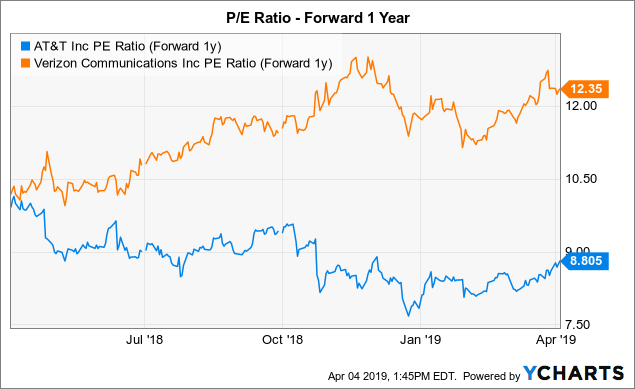
AT&T is extremely cheap for a reason, but the company should be able to close a lot of the multiple gap with top wireless competitor Verizon Communications (VZ). As much as my view questions the logic of the Time Warner merger, the stock has suffered far too much, if the management team stays on the debt repayment focus.

The market doesn’t expect much in the way of revenue growth for any company and the major 5G catalyst isn’t likely to show up until 2021 or after. For this reason, AT&T should close the forward P/E ratio gap with Verizon.

Chart

Data by YCharts

Analysts forecast AT&T to earn $3.63 per share in 2020. At 10x, the stock rallies to $36.30. At 11x, the stock rallied to $39.93. At this level, AT&T reaches my $40 price target and the dividend dips back towards normal levels at 5.1%.

Chart

Data by YCharts

Takeaway

The key investor takeaway is that as long as the AT&T executives stay on a singular focus of paying down debt with their excess free cash flows, the stock will close the P/E ratio gap with Verizon.

The CEO has made enough comments about only having this goal for 2019 suggesting an investor likely wants to get out when the stock rallies back to $40. The recent debt reduction could turn out to just be fool’s gold along with the concept of holding AT&T long term to collect the dividends.

Disclosure: I am/we are long T. I wrote this article myself, and it expresses my own opinions. I am not receiving compensation for it (other than from Seeking Alpha). I have no business relationship with any company whose stock is mentioned in this article.

Additional disclosure: The information contained herein is for informational purposes only. Nothing in this article should be taken as a solicitation to purchase or sell securities. Before buying or selling any stock you should do your own research and reach your own conclusion or consult a financial advisor. Investing includes risks, including loss of principal.

Jeff and MacKenzie Bezos Each Wrote Exactly 93 Words About Their Divorce. Here's a Truly Stunning Theory About Why They Did It

Jeff and MacKenzie announced the terms of their divorce on Twitter this week in two simultaneous statements. When I wrote about it yesterday, I now think I may have missed something intriguing.

First, the background. It’s fascinating and admirable that the Bezoses worked through their agreement so quickly:

  • MacKenzie keeps 25 percent of their Amazon stock (which works out to something like $35 billion). 
  • Jeff keeps the remaining 75 percent of the Amazon stock, plus the voting power of MacKenzie’s shares, plus their interests in The Washington Post and Blue Origin.

When I wrote yesterday, I pointed out three things that I found unusual — but endearing — in the statements:

  1. They posted the statements almost simultaneously. 
  2. They used the same word, “grateful” twice each, which set the tone of the whole thing in a very positive way.
  3. They each wrote the exact same length: 93 words.

That last detail caught me. Why would they write 93 words each. Could it possibly be a coincidence? Hmmm. 

93 words

I’d only noticed this because I had to retype the statements into a text document. Being a word nerd, I also noticed that MacKenzie Bezos’s statement (embedded at the end of this article) doesn’t include many first person pronouns. 

For example, she writes: “Grateful to have finished the process of dissolving my marriage with Jeff…” instead of “I’m grateful to have finished….”

Actually every sentence is like that. 

I know people sometimes skip first person pronouns, and Twitter is informal, etc. But if she had included all the “I am” clauses, the statements would be uneven. She’d have more than 93 words.

Okay, this was really weird. I didn’t want to be known as a “Bezos Divorce Tweet Truther.” But was there something going on here? Did they agree on 93 words exactly?

And if so, why that number?

September 4, 1993

Then, a reader emailed me with an observation: “the obvious symbolism of the 93 words is they were married in ’93.”

Oh wow. The reader, who didn’t want to be identified, is right at least about the date. The Bezoses were married on September 4, 1993.

I haven’t heard back. I tried [email protected] as well, because why not? But it bounced back.

So I can’t confirm this “93-words-for-1993” theory, obviously. All I can do is put these intriguing facts in front of you, and share what I think of them.

My response is that if it’s true, it’s poignant and beautiful. The writer in me likes to think it’s a communication in a shared voice, going beyond the text itself.

It leaves me thinking about what was, what might have been, and what their relationship will be going forward.

Suspend your disbelief

Suspend your disbelief for just a second. Accept that it’s probably just a coincidence but then allow yourself to imagine what it means if it wasn’t.

Imagine if during the chaos of what could have been one of the most contentious and costliest divorces in history, Jeff and MacKenzie Bezos quickly reached an agreement — not just on the big things, but on the little things, down to the length of their joint statement.

Suspend that disbelief just a bit longer, and ask yourself if it’s possible they chose 93 words for this special, sentimental reason.

Put that with their repeated symmetrical use of the word, “grateful,” and of the repeated phrases in each statement: “friends and co-parents,” and “co-parents an friends.”

Add to it how they both agreed with the language in MacKenzie’s post, where she says she’s “[h]appy to be giving Jeff all of my interests in The Washington Post and Blue Origin and 75% of our Amazon stock.”

Emphasis added there, since this phrasing is instead of Jeff saying he’s giving something to MacKenie, or them both saying they were splitting the assets. It’s MacKenzie giving what she owns to Jeff. That’s powerful.

I’m impressed. I’m a filled with a bit of awe. And, I find myself offering them both condolences and congratulations on the whole situation. 

Netflix looms large as theater owners assess industry future

LAS VEGAS (Reuters) – As movie theater owners converge on Las Vegas for their annual convention, one topic that keeps coming up is how they contend with a company that has resisted their traditional business model: Netflix Inc.

FILE PHOTO: The Netflix logo is seen on their office in Hollywood, Los Angeles, California, U.S. July 16, 2018. REUTERS/Lucy Nicholson/File Photo

The world’s most successful streaming service sends some movies to theaters but has insisted on making them available on Netflix at the same time, or just a few weeks later. That has upset big movie chains, which refuse to show Netflix films and want a longer “window” of time to play films exclusively.

The issue of how Netflix fits into, or threatens, the theater business dominated a press conference on Tuesday at CinemaCon, the theater industry trade show.

“All of your questions from the first 17 minutes or whatever are about Netflix,” grumbled John Fithian, president and chief executive of the National Association of Theatre Owners.

He insisted that Netflix and theaters can happily co-exist, citing data that showed the biggest consumers of streaming video visit theaters more often. He also said Netflix had helped revive interest in documentaries, which had helped draw people to theaters to see them.

Earlier, Fithian told a crowd in a Caesars Palace theater that films reached their full potential only with a “robust theatrical release.” He spoke just after “Crazy Rich Asians” director Jon M. Chu said his film would not have had as big an impact if it had debuted on a streaming service.

Some members of the Academy of Motion Picture Arts & Sciences, the group that hands out the Oscars, have been debating whether films must play in theaters for a specific length of time to compete for the awards, which could exclude Netflix or force the company to agree to longer exclusive theatrical runs.

Hollywood publication Variety reported on Tuesday that the Department of Justice had weighed in on the issue.

Antitrust chief Makan Delrahim sent a letter to the academy warning that any changes that limited eligibility for the industry’s highest honors “may raise antitrust concerns,” according to Variety.

An academy spokesperson confirmed it had received the letter and said any rule changes would be considered at an April 23 meeting. A source close to Netflix said the company was not involved with or aware of the Justice Department’s letter.

Netflix is a member of the Motion Picture Association of America, the trade association for Walt Disney Co, AT&T Inc’s Warner Bros. and other movie studios.

“We are all stronger advocates for creativity and the entertainment business when we are working together … all of us,” MPAA CEO Charles Rivkin said on the CinemaCon stage.

Both Rivkin and Fithian noted that box office receipts hit a record $11.9 billion in the United States and Canada in 2018 even as Netflix released dozens of original movies.

Mitch Neuhauser, managing director of CinemaCon, also was asked to address the issue when he wandered into a work room for reporters.

“Streaming is not a problem!” he exclaimed, noting that there are limits to how much people can stand to stay at home with all of the modern conveniences including grocery delivery.

“We’ve got to get out of the house. We are talking about becoming a society of hermits!”

Reporting by Lisa Richwine in Las Vegas; Additional reporting by Kenneth Li in New York and Jill Serjeant in Los Angeles; Editing by Sonya Hepinstall

Cranfield gets Rubrik backup plus Nutanix in drive to the cloud

Cranfield University has replaced its Veeam and Data Domain backup infrastructure for one comprising Rubrik backup appliances and Microsoft Azure cloud storage.

In doing so, it has cut its on-site hardware footprint from 24U to 4U, slashed equipment and licensing costs, and reduced data restore times from hours or days to minutes.

The move also gives Cranfield peace of mind in disaster recovery by gaining the ability to run all operations from any location using virtual servers running in Azure, should the entire site become unavailable.

The refresh comes alongside one in which the university replaced its existing Pure Storage flash storage arrays with 12 nodes of Nutanix hyper-converged infrastructure hardware.

The entire project is a drive towards simplifying Cranfield’s on-site physical infrastructure in a move that encompasses cloud as a site for storage (and compute in case of outages).

Cranfield is a leading research establishment in science, industry and technology, with 1,600 staff and 4,000 postgraduate students.

Its IT stack is based around Microsoft and Linux servers with Microsoft and Oracle-based applications. It is effectively 100% virtualised on VMware, with 400-600 virtual machines running at any one time.

Its existing backup infrastructure was based on Veeam backup software and Data Domain hardware, with replication to a third party-hosted Data Domain box.

That setup had reached end of life and was showing the signs, said head of IT infrastructure Edward Poll.

“Data Domain did what it was supposed to do, but it was time to refresh things and we wanted to reduce costs, management time and complexity, and increase performance,” he said.

“The major issue with Data Domain had become restores. It ingests well, but recovering was more problematic. It would be fine for one restore, but if we’d had to restore multiple – 50, 100 or 150 – servers, we would have struggled.”

Cranfield’s IT department had already started a journey towards cloud by using StorSimple appliances – with about 80TB on site and 0.5PB in the Azure cloud – and had discovered how cost-effective it can be.

“Azure was a good fit and we started by thinking we could use Veeam and Data Domain instances in the cloud, but it was suggested to us, ‘why not get rid of a layer of software?’, and we looked at using Rubrik appliances,” said Poll.

Rubrik is part of an emerging category of backup appliances that come as nodes that build into clusters in a similar way to hyper-converged infrastructure.

Rubrik’s software appliance can come on approved server hardware from Cisco, HPE or Dell with flash and spinning disk inside. Capacities for a minimum four-node cluster are in the 64TB-160TB range, depending on the hardware.

Customers can set policies to specify how long data should be retained as a backup and which can be accessed for production use from Rubrik hardware. Rubrik backup data is seen as an NFS file share before being sent to an in-house physical archive or the cloud.

Cranfield has deployed eight Rubrik R348S nodes with a total of about 80TB of storage on site, with flash and SAS spinning disk tiers of storage inside. Data is ingested, then copied off to the Azure cloud.

The key benefits for Poll’s team are the substantially better restore times, plus the ability to potentially restore virtual machines in the cloud, allowing staff to work from any location in the event of a disaster.

Rubrik’s CloudOn enables rapid recovery to allow for business continuity in the event of a disaster, said Poll. “If our on-prem site is down, we can quickly convert our archived VMs into cloud instances, and launch those apps on-demand in Azure,” he added.

“We don’t notice any difference in data ingest, but performance on restores is very much better.”

In cost terms, Cranfield had been spending £50,000 a year on off-site hosting. It now spends about £25,000 a year with Microsoft Azure.

Meanwhile, time spent managing backup is down from about half a day a week to five minutes a day.

In terms of physical space and equipment savings, Poll said the university had turned off 42U of storage and backup devices, of which backup servers and Data Domain comprised 24U.

“Overall, it has given us a simpler, faster and more reliable backup service,” he said. “It is more easily integrated with a department that is moving towards a DevOps model, and when it comes to data recovery, we are down to minutes rather than many hours.”

The storage and backup refresh – with the move towards hyper-converged infrastructure – forms part of a wider plan to rationalise IT by making use of contemporary devices’ formats with a smaller physical footprint, as well as the cloud.

Poll added: “The university masterplan is to knock down the IT department and to no longer have two large datacentres on site. Instead, there will be one datacentre, a ‘resiliency room’ for redundancy of network equipment, and the cloud.”

AT&T's Cash Cow Is Changing

AT&T (T), as one of the largest telecommunications companies in the world, is a large and complicated enterprise. It has multiple operating segments, some of which have multiple sub-segments, which make up the enterprise, and each of these are important to the firm, its future prospects, and its shareholders. When you really drill down deep into the business though, while it really is an aggregation of smaller (but still very large) firms, the core of what makes AT&T the behemoth it is today is also its largest cash cow: Mobility. In recent years, growth there has been essentially non-existent, but that’s only at face value. When you consider the paradigm shift taking place in the industry, it becomes clear that growth for the business should resume, but it will take a little time.

Mobility is significant

Mobility is, in the simplest terms I can conjure, AT&T’s sub-segment listed under its Communications segment that offers customers across the US with wireless services and related equipment. If you envision AT&T as primarily a cellphone and cellphone services provider, then Mobility is precisely what you’re thinking of and your thought process would be correct. While Communications as a whole would make for an interesting discussion, though, my primary emphasis in this piece is to discuss Mobility specifically.

Over the past few years, anybody looking at Mobility’s revenue would be certainly underwhelmed. Sales back in 2016 came in at $72.59 billion. They dropped modestly to $71.09 billion in 2017 before ticking up to $71.34 billion last year. Though technically down over this three-year period, the extent of the decline is such that it’s about the same as saying sales are essentially flat.

Created by Author

What’s really interesting about these revenue figures is how they break down on a service vs. equipment basis. Service sales have dropped materially since 2016, declining from $59.15 billion then to $54.93 billion today. Equipment sales have mostly made up for this, soaring from $13.44 billion to $16.41 billion. Though this may seem odd, I’ll explain later in this article why this likely is.

On the bottom line, things are going quite well for AT&T’s Mobility operations. Segment profits have actually ticked up, rising from $20.74 billion in 2016 to $21.72 billion last year. On a margin basis, this translates to improvement over time, with the segment profit margin climbing from 28.6% in 2016 to 30.4% as of last year. What’s really remarkable about Mobility is the fact that, despite it accounting for just 41.2% of the company’s overall revenue during 2018, it accounted for an impressive 56.3% of the business’s segment profits and for 67.3% of AT&T’s Communications segment’s profits. Given how integral this is to the business, there’s no doubt in my mind that you can consider Mobility to be a cash cow.

The picture is distorted

Sometimes when you look at a company’s financials, the first glance gives a great view of how things really are going, while other times the picture is distorted. AT&T is a case of the latter. If you looked solely at sales, and even segment profits, you would think the business has stagnated and that, perhaps, the future will be worse (or at least no better) than the past. This thought might be strengthened, even, for investors who look at AT&T’s wireless subscriber count and see that from 2016 to 2018 it fell from 77.37 million accounts to 76.89 million.

Created by Author

When you really dig deep, though, you see that the composition of these wireless subscribers is looking favorable for the company long-term. Between 2016 and 2017, for instance, the business saw the number of postpaid smartphone subscribers rise 2.7% from 59.10 million to 60.71 million. Its postpaid feature phone subscribers, meanwhile, were responsible for the decline, falling 11.5% from 18.28 million to 16.18 million. The difference between smartphone and feature phone subscribers is that the latter are those customers who own a cheaper phone, one with limited functionality but that comes at a budget price point. What this trend indicates is that more and more consumers are shifting toward the premium smartphone market and away from cheaper alternatives.

In the past, I have written about the Connected Devices operations within the Mobility sub-segment and those too are undeniably helpful for the firm’s operations, both now and for the future. Because I have dug into that area before, though, I will not rehash those details here, but will refer you to my latest article on the topic. Outside of Connected Devices and postpaid smartphones, however, another hot market for AT&T is the prepaid side. The company’s subscriber count there grew much higher between 2016 and 2018, climbing 25.6% from 13.54 million to 17 million. Should this trend continue as well, it will help to offset the decline in prepaid feature phone subscribers.

This brings me back now to the company’s service revenue vs. its equipment revenue. Equipment revenue is rising for two reasons. The first, according to management, was a change in accounting principles that affected how it recognizes sales from bundled contracts, and the second was due to the sale of higher prices. As fewer featured phone subscribers exist and shift more toward smartphones, a trend that is simply inevitable, this should continue. On the service side, the firm benefited from higher prepaid service revenues, but what more than offset these sales increases were shifts toward more unlimited plans by customers, combined with an accounting policy change that affected the picture in a negative way for Mobility to the tune of $1.74 billion in 2018 compared to 2017.

Takeaway

Right now, the picture facing AT&T’s Mobility operations is complex and multi-faceted, but contrary to potential concerns that the company’s core business, its cash cow if you will, is doing poorly, we have data that suggests that the issues in recent years can be chalked up largely to one-time changes and a shift of consumers to unlimited plans and away from low-priced phones and toward higher-priced ones. As postpaid feature customers wind down, negative pressure on Mobility’s sales will ease and the sub-segment should benefit not only from its higher-margin activities, but also from the new sales mix that will lead it into the future. For long-term investors, this looks set to create a bullish scenario for the firm, but it will require a great deal of patience and a true long-term mindset.

Disclosure: I/we have no positions in any stocks mentioned, and no plans to initiate any positions within the next 72 hours. I wrote this article myself, and it expresses my own opinions. I am not receiving compensation for it (other than from Seeking Alpha). I have no business relationship with any company whose stock is mentioned in this article.

Facebook Had a Busy Weekend, From News Feed to Livestream Changes

While millions of Americans were enjoying a warm spring weekend, Facebook employees were hard at work responding to an avalanche of news about their company. After an already busy week for the social media platform—including a lawsuit from the Department of Housing and Urban Development, as well as a policy change regarding white nationalist and separationist content—five major Facebook stories broke over the last few days, including a Washington Post op-ed in which CEO Mark Zuckerberg calls for the social network to be regulated. Here’s what you need to know to get caught up.

Facebook Explores Restricting Who Can Livestream

The torrent of Facebook news began Friday, when COO Sheryl Sandberg said the company was “exploring restrictions on who can go Live depending on factors such as prior Community Standard violations.” The decision came less than three weeks after a terrorist attack in Christchurch, New Zealand, that killed 50 people was livestreamed on Facebook. The social network, as well as other companies like YouTube, struggled to stop the shooter’s video from being reuploaded and redistributed on their platforms.

In 2016, Zuckerberg said that live video would “create new opportunities for people to come together.” Around the same time, the company invested millions of dollars to encourage publishers like Buzzfeed to experiment with Facebook Live. The feature provided an unedited, real-time window into events like police shootings, but it was also repeatedly used to broadcast disturbing events. After the Christchurch attack, Facebook is now reexamining who should have the ability to share live video, which has proven difficult for the company to moderate effectively.

Sandberg also said Facebook will research building better technology to “quickly identify edited versions of violent videos and images and prevent people from re-sharing these versions.” She added that Facebook had identified over 900 different variations of the Christchurch shooter’s original livestream. Sandberg made her announcement in a blog post published not to the Facebook Newsroom but to Instagram’s Info Center, indicating Facebook wants its subsidiaries to appear more unified.

Old Zuckerberg Blog Posts Disappear

Also on Friday, Business Insider reported that years of Zuckerberg’s public writings had mysteriously disappeared, “obscuring details about core moments in Facebook’s history.” The missing trove included everything the CEO wrote in 2007 and 2008, as well as more recent announcements, like the blog post Zuckerberg penned in 2012 when Facebook acquired Instagram.

Facebook said that the posts were mistakenly deleted as the result of technical errors. “The work required to restore them would have been extensive and not guaranteed, so we didn’t do it,” a spokesperson for the company told Business Insider. They added that they didn’t know exactly how many posts were lost in total.

This isn’t the first time Zuckerberg’s content has gone missing from Facebook. Last April, TechCrunch reported that some of the CEO’s messages were erased from people’s private inboxes. (Facebook later extended an “unsend” feature to all Facebook Messenger users.) And in 2016, “around 10” Zuckerberg blog posts also disappeared from the social network. The deletion was similarly blamed on a technical error, but in that case the blogs were later restored.

Zuckerberg Calls for Regulation in Four Areas

In an interview with WIRED last month, Zuckerberg said, “There are some really nuanced questions … about how to regulate, which I think are extremely interesting intellectually.” On Saturday, the Facebook CEO expanded on that idea in an opinion piece published in The Washington Post. “I believe we need a more active role for governments and regulators,” Zuckerberg wrote, calling for new regulation in four particular areas: harmful content, election integrity, privacy, and data portability.

In the piece, Zuckerberg acknowledged that he believes his company has too much power when it comes to regulating speech on the internet. He also mentioned Facebook’s new independent oversight board, which will decide on cases where users have appealed the content decisions made by Facebook’s moderators. (On Monday, Facebook announced it was soliciting public feedback about the new process.)

Zuckerberg also said the rest of the world should adopt comprehensive privacy legislation similar to the European Union’s General Data Protection Regulation that went into effect last year. There’s currently no modern privacy law in the United States, though California passed a strong privacy bill last summer, which Facebook originally opposed. Now a number of lawmakers, and lobbyists, are jockeying to get a federal privacy law in place before the state-level rules take effect next year.

The op-ed arrives as Facebook faces a looming Federal Trade Commission investigation over alleged privacy violations. Lawmakers on both sides of the aisle have also recently expressed an interest in regulating or even breaking up the social media giant. Zuckerberg’s op-ed provides a sketch of the kind of regulation that his company would be comfortable adopting. Some critics have also argued that legislation like GDPR can strengthen the dominant position of companies like Facebook and Google.

Facebook Opens Up About How News Feed Works

How Facebook chooses what content to feature in the News Feed has consistently remained mostly a mystery. As Will Oremus wrote last week in Slate, “For all of Facebook’s efforts to improve its news feed over the years, the social network remains as capricious and opaque an information source as ever.”

But on Sunday evening, Facebook quietly announced that it will begin revealing more about why users see one post over another when they scroll through their feeds. The company will soon launch a “Why am I seeing this post?” button, similar to the one it launched in 2014 for advertisements. It will begin rolling out this week and will be available for all Facebook users by the middle of May, according to Buzzfeed.

“This is the first time that we’ve built information on how ranking works directly into the app,” Ramya Sethuraman, a product manager at Facebook, wrote in a blog post. The new feature might tell users, for example, that they’re seeing a post because they are friends with someone on Facebook or because they joined a specific group. But the button will also provide more granular information, such as telling users they’re seeing a specific photo because they’ve “commented on posts with photos more than other media types.”

Facebook is also making updates to its preexisting “Why am I seeing this ad?” button. It will now tell users when an advertiser has uploaded their contact information to Facebook. In addition, it will show users when advertisers work with third-party marketing firms. For example, an ad for a shoe company might reveal the name of the marketing agency it hired to sell its new sandals.

Pivot to Paying Publishers?

On Monday morning, Zuckerberg suggested he might create a new section of Facebook dedicated to “high-quality news.” Details are scarce, but it may feature content Facebook pays publishers directly to share. The remarks were made during an interview Zuckerberg did with European media executive Mathias Döpfner, which the CEO posted to his personal Facebook page. The announcement comes a year after Facebook said it would begin deprioritizing news stories in its News Feed in favor of content from friends and family.

Last week, Apple announced it was launching a $10 per month paid news aggregation service called News+ (it features content from WIRED). But unlike Apple, Facebook doesn’t appear to be getting into the subscription business. “We’re coming to this from a very different perspective than I think some of the other players in the space who view news as a way that they want to maximize their revenue. That’s not necessarily the way that we’re thinking about this,” Zuckerberg said in the interview.

Facebook’s earlier attempts to partner with media organizations have been a mixed bag. The social network also previously explored creating a dedicated feed for publishers but abandoned the project. Without knowing more, it remains to be seen what, if anything, is going be different this time.


More Great WIRED Stories

Ignore The Yield Curve, They Said…

A Run For The Highs

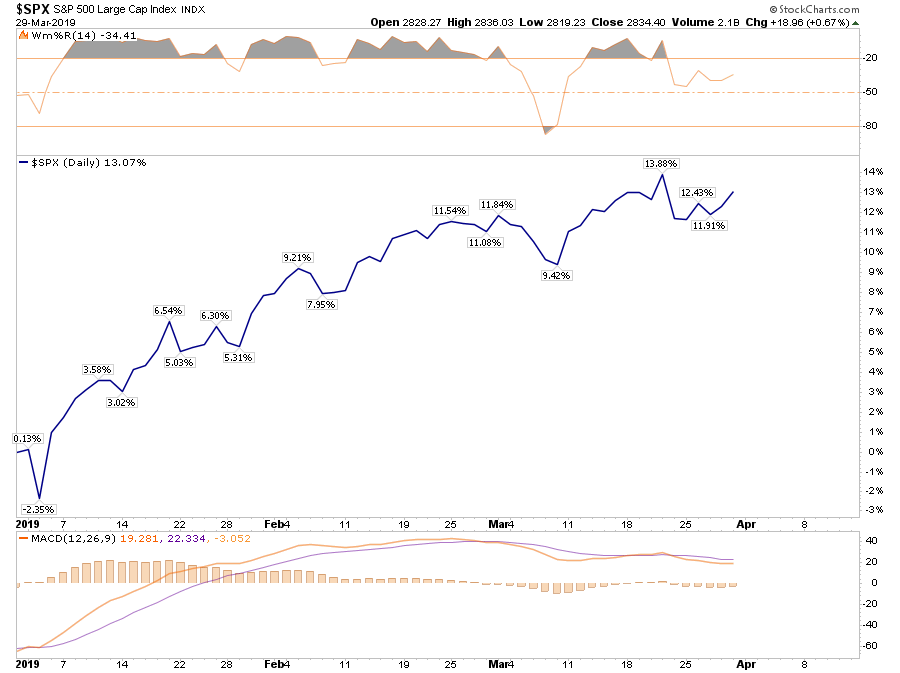
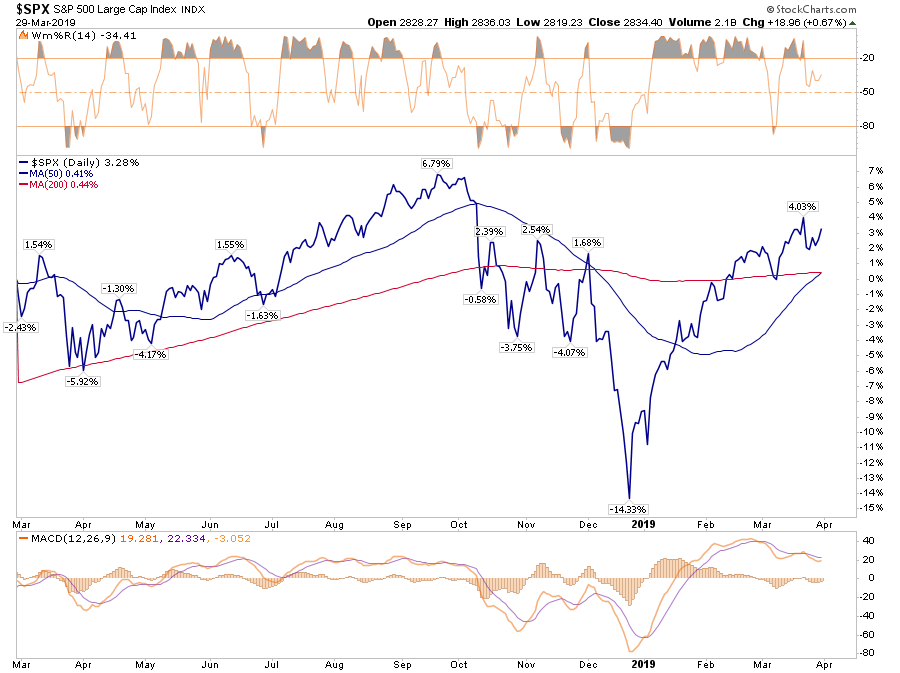
Friday wrapped up the first quarter of 2019, and it was the best quarterly performance since 2009. As shown in the chart below, if you bought the bottom, you are “killing it.”
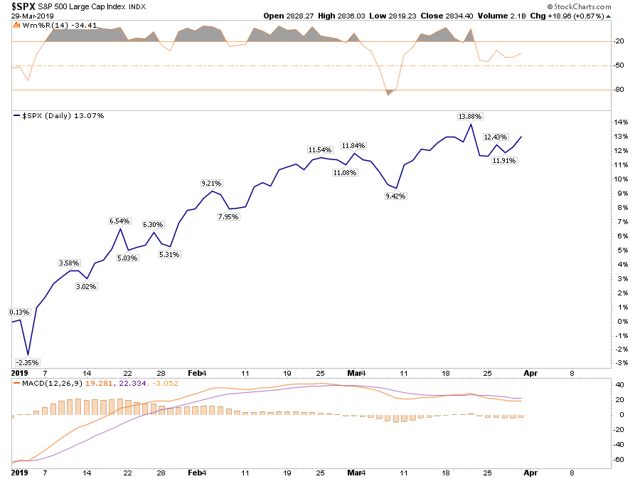
However, you didn’t.

Despite all of the media “hoopla” about the rally, the reality is that for most, they are simply getting back to even over the last year.
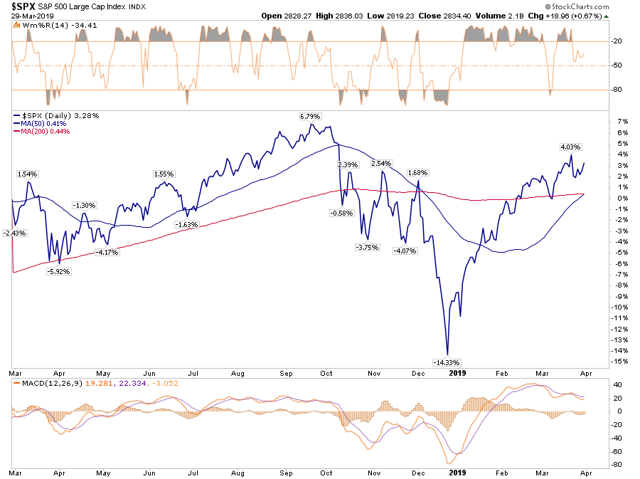
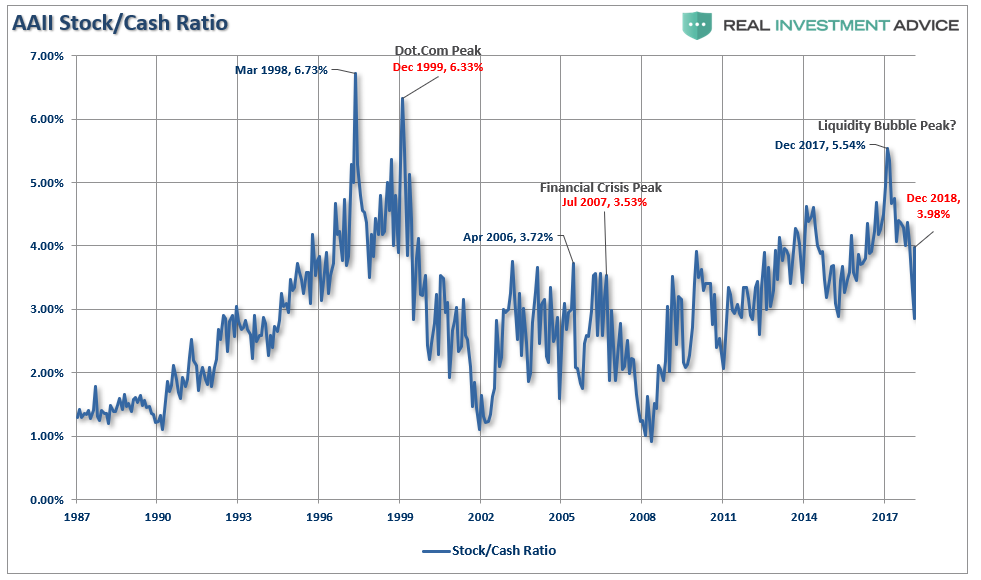
That is, assuming you didn’t “sell the bottom” in December, which by looking at allocation changes, certainly appears to be the case for many.
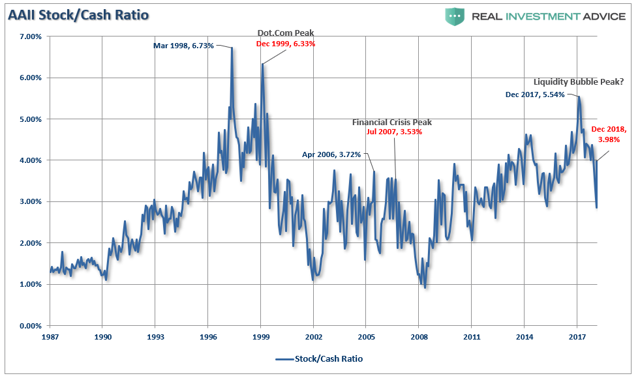
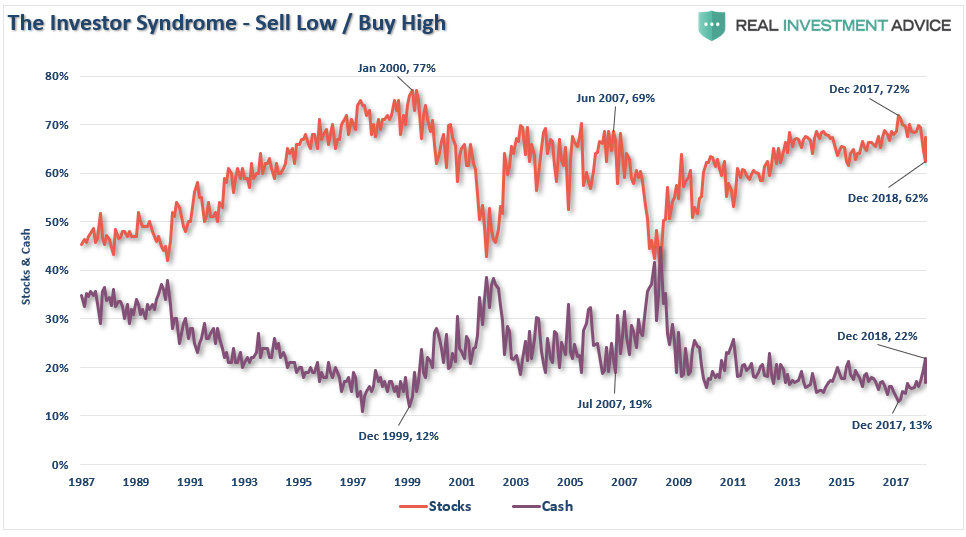
If we deconstruct the ratio, we can see the rotation a bit better
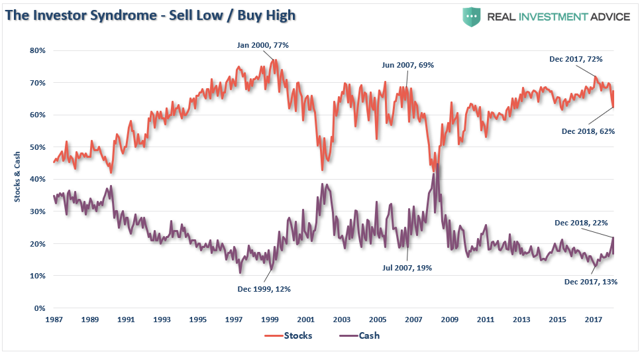
Not surprisingly, historically speaking, investors had their peak stock exposure before the market cycle peak. As the market had its first stumble, investors sold. When the market bounces, investors are initially reluctant to chase it. However, as the rally continues, the “fear of missing out or F.O.M.O” eventually forces them back into the market. This is how bear market rallies work; they inflict the most pain possible on investors both on the bounce and then on the way back down.

However, for the moment, we are still in the midst of a bear market rally. This will be the case until the market breaks out to new highs. Only then can we confirm the previous consolidation is complete and the bull market has been re-established.

The good news is on a very short-term basis, the market IS INDEED bullishly biased and coming off an extremely strong first-quarter rally. The current momentum of the market is strong as bullish optimism has regained a foothold.

But, as we noted for our RIA PRO Subscribers last week, complacency has moved back to extremes which suggests that a further rally isn’t “risk free.”

“The graph below is constructed by normalizing VIX (equity volatility), MOVE (bond volatility) and CVIX (US dollar volatility) and then aggregating the results into an equal-weighted index. The y-axis denotes the percentage of time that the same or lower levels of aggregated volatility occurred since 2010. For instance, the current level is 1.91%, meaning that only 1.91% of readings registered at a lower level.
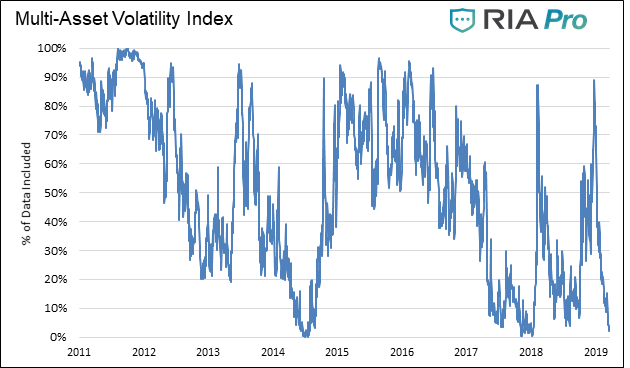
“Beyond the very low level of volatility across the three major asset classes, there are two other takeaways worth pondering.

The peak-to-trough-to-peak cycle over the last year was measured in months not years as was the case before 2018.

Secondly, when the index reached current low levels in the past, a surge in volatility occurred soon after that. This does not mean the index will bounce higher immediately, but it does mean we should expect a much higher level of volatility over the next few months.”

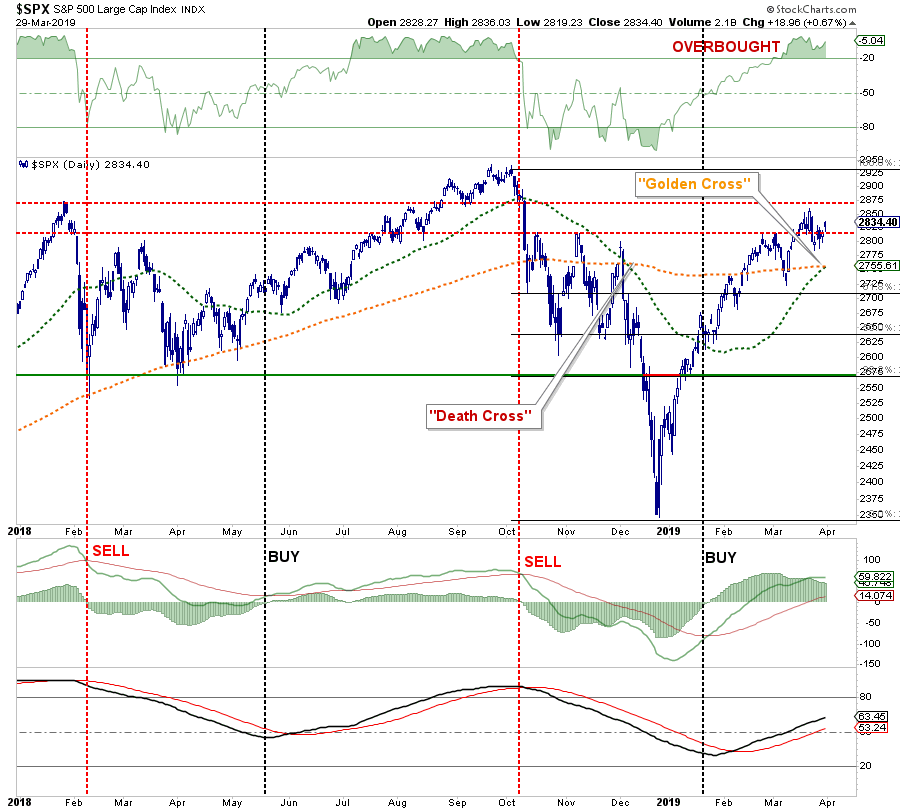
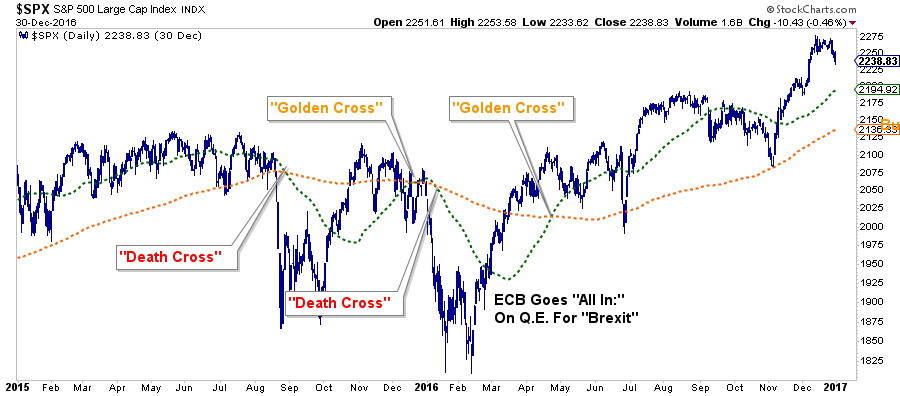
Nonetheless, the markets are close to registering a “golden cross.” This is some of that technical “voodoo” where the 50-day moving average (dma) crosses above the longer-term 200-dma. This “cross” provides substantial support for stocks at that level and limits downside risk to some degree in the short term.
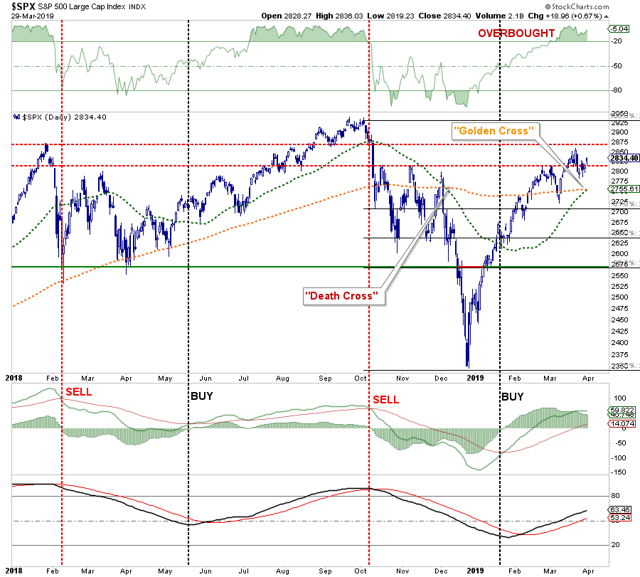
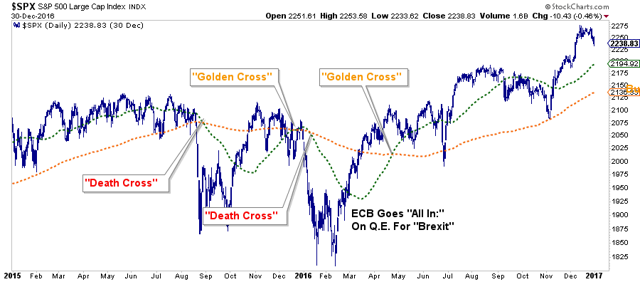
Over the next couple of weeks, you are going to see a LOT of commentary about “the Golden Cross” buy signal and why this means the “bull market” is officially back in action. While “golden crosses” are indeed bullish for the markets, they are not an infallible signal. The chart below shows the 2015-2016 market where investors were whipsawed over a 6-month period before massive central bank interventions got the markets back on track.
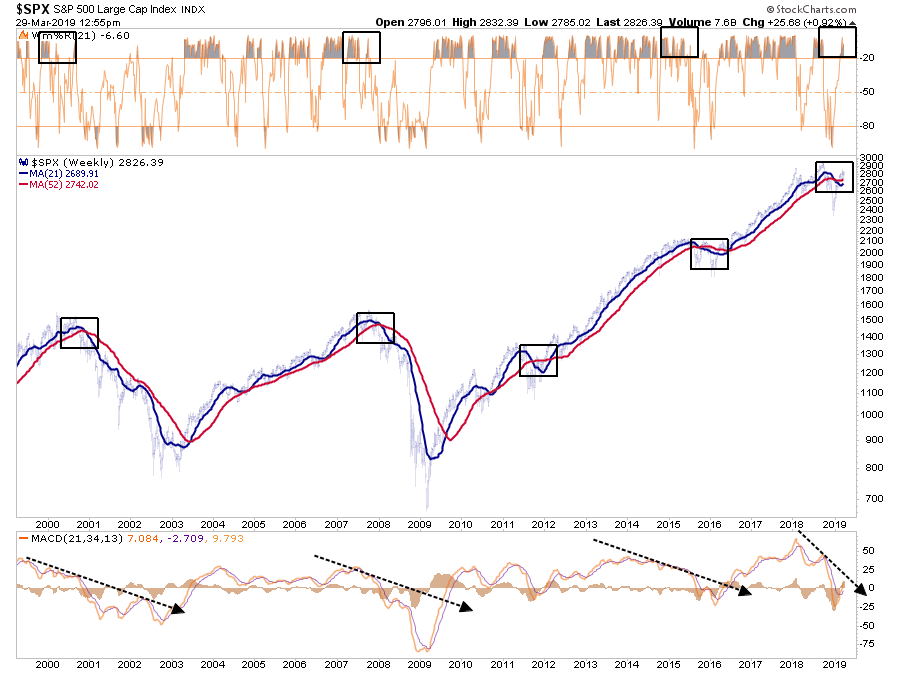
The next chart shows the longer-term version of the chart above using WEEKLY data. The parameters are set for a slightly longer time frame to reduce the number of “false” indications. I have accentuated the moving averages to have them more clearly show the crosses.
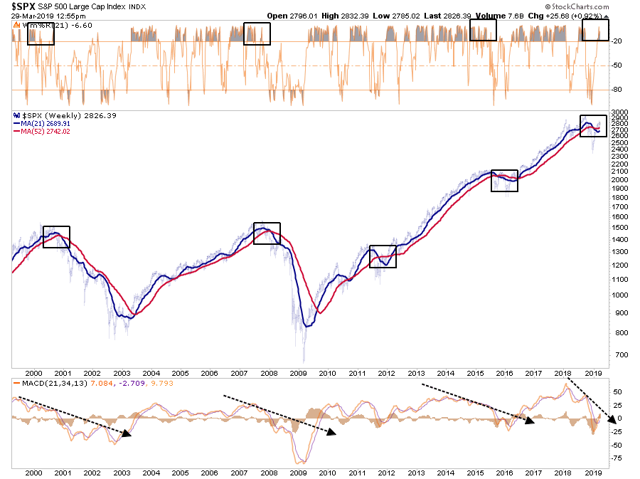
The one thing that you should notice is the negative “cross over” is still intact AND it is doing so in conjunction with an extreme overbought weekly condition and a “negatively diverging” moving average divergence/convergence (MACD) indicator. This combined set of “signals” has only been seen in conjunction with the previous market peaks. (As noted, the corrections of 2012 and 2015-16 were offset by massive amounts of central bank interventions which are not present currently.)

From a portfolio management standpoint, what should you do?

In the short term, the market remains bullishly biased and suggests, with a couple of months to go in the “seasonally strong” period of the year, that downside risk is somewhat limited.

Therefore, our portfolio allocations:

  • Remain long-biased towards equity risk;
  • Have a balance between offensive and defensive sector positioning; and
  • Are tactically positioned for a trade resolution (which we will sell into the occurrence of).

However, the analysis also keeps us cautious with respect to the longer-term outlook. With the recent inversion of the yield curve, deteriorating economic data, and weaker earnings prospects going forward, we are focused on risk management and capital controls. As such, we are:

  • Continuing to carry slightly higher levels of cash;
  • Overweight bonds;
  • Have some historically defensive positioning in portfolios;
  • Continue to tighten-up stop-loss levels to protect gains, and;
  • Have outright hedges ready to implement when needed.

Ignore The Yield Curve… They Said

In the World War II real-time strategy (RTS) game Company of Heroes, released on September 12th, 2006, the engineer squad would sometimes say:

“Join the army they said. It’ll be fun they said.”

Since then, the statement has become a common meme on the internet to espouse the disappointment derived from various actions from doing the laundry to getting a job.

Well, the latest suggested action, which will ultimately lead to investor disappointment, is:

“Ignore the yield curve they said. It’ll be fun they said.”

Last week, Mark Kolanovic of J.P. Morgan stated:

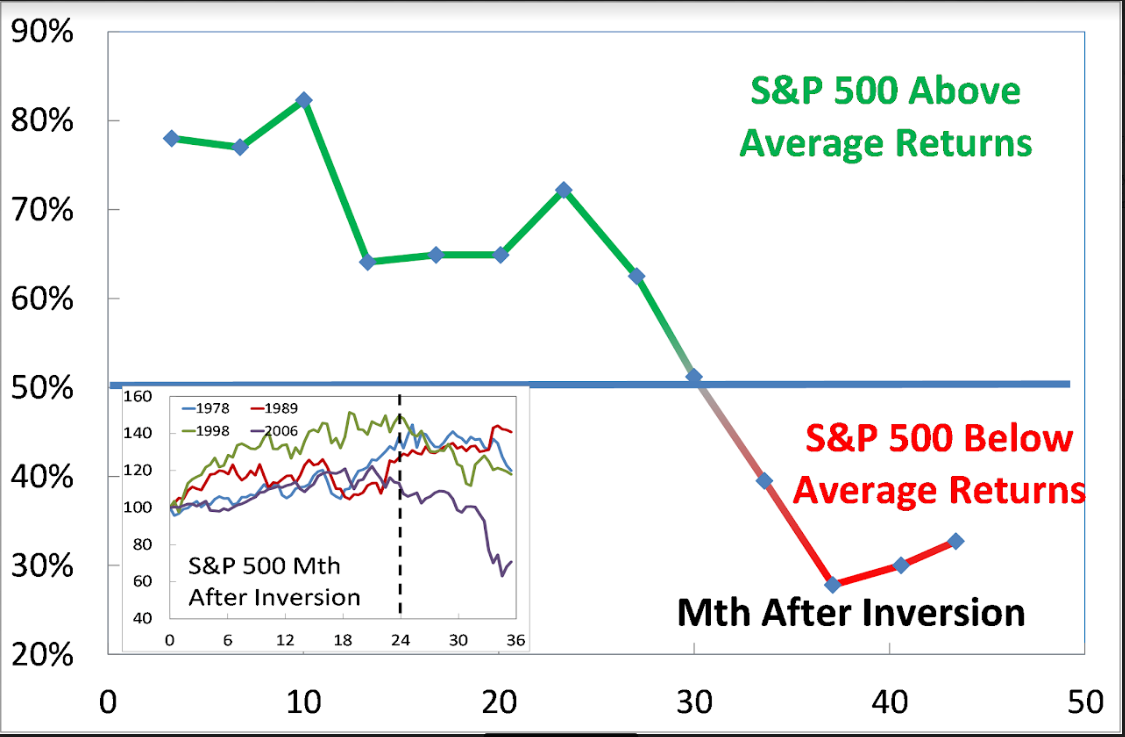
“Historically, equity markets tended to produce some of the strongest returns in the months and quarters following an inversion. Only after [around] 30 months does the S&P 500 return drop below average,”
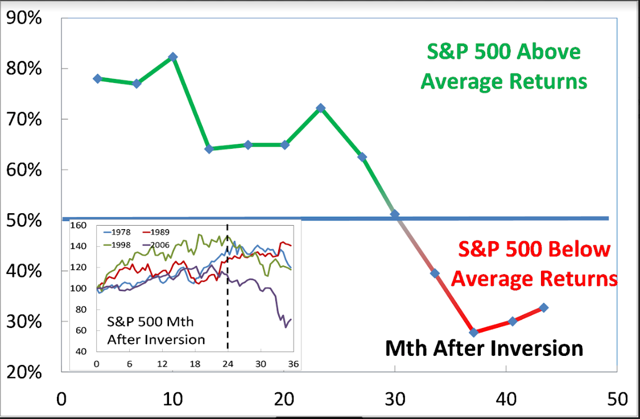
While the statement is not incorrect, it is advice that will ultimately lead to disappointment.

In 1998, for example, as the bull market was running hot. There was “no recession in sight,” and investors were repeatedly advised to ignore the yield curve because “this time was different.”

After all, at that moment in history, it was perceived to be a “new paradigm.” The internet was changing the world and making old metrics, like earnings, relics of the past. It was even suggested at the time that “investing like Warren Buffett was like driving Dad’s old Pontiac.”

Over the next two years, that advice held true as bullish optimism seemed well founded. It was in early 2000 that Jim Cramer issued his Top 10-Stock Picks for the next decade.

The problem is that no one ever said “sell.”

While it was great that gains were made during the period between the initial yield curve inversion and the peak of the market, all of those gains, plus much more, were wiped out in the ensuing decline. Values in portfolios were returned to where they were roughly a decade earlier by the time the decline was officially over.

Since the majority of mainstream financial advice never suggest selling, investors had no clue that if they had gone to cash in 1998, they would have saved themselves both a lot of grief and years of losses needing to be recovered.

It was just an anomaly.

That was the belief at the time. Following the “Dot.com” crash, the entire tragic event was considered an anomaly; a once-in-a-100-year event which would not be replicated anytime again soon.

But just 4 years later, in 2006, investors were once again told to ignore the yield curve inversion as it was a “Goldilocks economy” and “sub-prime mortgages were contained.” While many of the individuals who had told you to stay invested leading up to 2000 peak were mostly gone from the industry, a whole new crop of media gurus and advisors once again told investors to “ignore the yield curve.”

For a second time, had investors just sold when the yield curve inverted, the amount of damage that would have avoided more than paid off for the small amount of gains missed as the market cycle peaked.

This quad-panel chart below shows the 4 previous periods where 50% of 10 different yield curves were inverted. I have drawn a horizontal red dashed line from the first point where 50% of the 10-yield curves we track inverted. I have also denoted the point where you should have sold and the subsequent low.

As you can see, in every case, the market did rally a bit after the initial reversion. However, had you reduced your equity-related risk, not only did you bypass a lot of market volatility (which would have led to investor mistakes anyway) but ended up better off than those trying to just ride it out.

That’s just history

Oh, as we noted last week, we just hit the 50% mark of inversions on the 10 spreads we track.
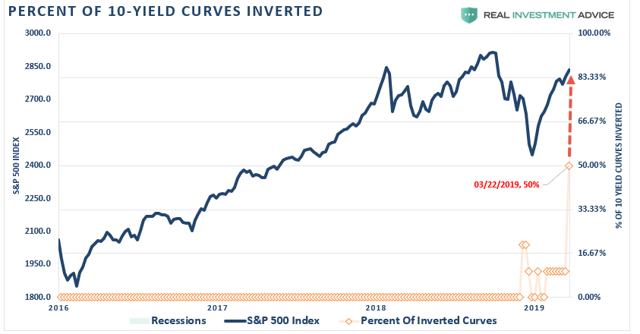
This time is unlikely to be different.

More importantly, with economic growth running at less than 1/2 the rate of the previous two periods, it will take less than half the amount of time for the economy to slip into recession.

While I am not suggesting you sell everything and go to cash today, history is pretty clear that you will likely not miss much if you did.

What Can You Do?

I don’t disagree that the markets could certainly rise from here, in the short term. I answered this question last week:

“Are we going to hit new highs you think, or is this a setup for the real correction?”

The answer is “yes” to both parts.

The mainstream media’s advice is simply:

“Since you don’t know when a bear market will start, you just have to ride it out.”

This is the problem with the mainstream media and the majority of the financial advice in the world today.

It is not required that you know precisely when one market cycle ends and another begins.

Investing isn’t a competition. It is simply a game of survival over the long term. While it is critically important we grow wealth while markets are rising, it is NOT a requirement to obtain every last incremental bit of gain there is. Staying too long at the poker table is how you leave broke.

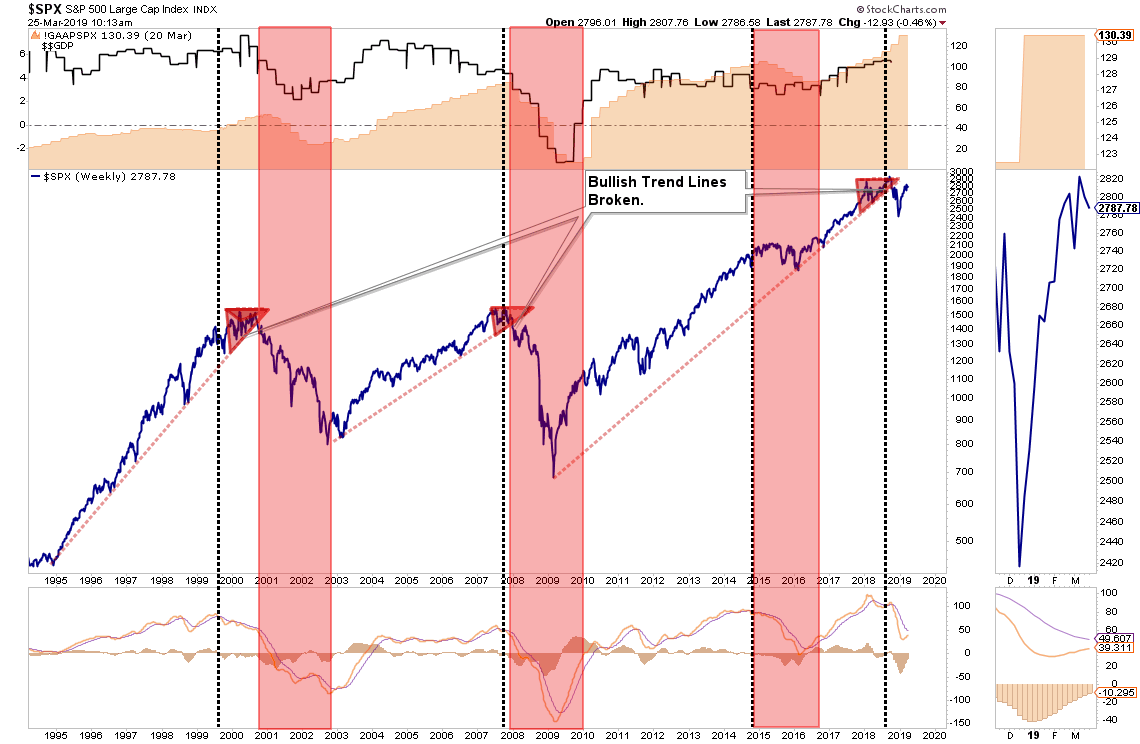
We wrote in early 2018 the bull market had come to its conclusion for a while. That correction process is still intact as shown in the chart below.

There are three important things worth pointing out:

  1. The top panel is GAAP earnings (what companies REALLY earn) and nominal GDP.
  2. The black vertical line is when the markets begin to “sniff out” something is not quite right.
  3. The red bars are when “expectations” are disappointed.
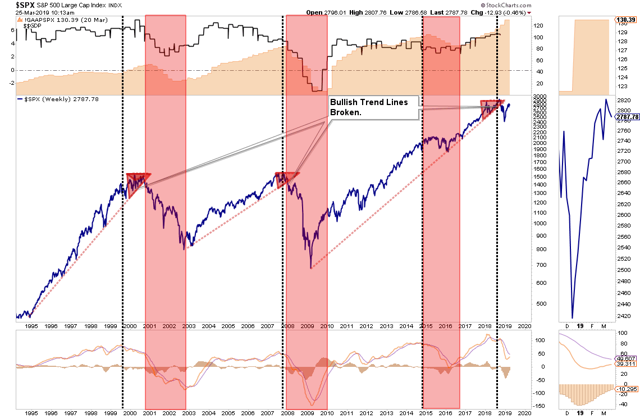
Pay attention to these longer-term trend changes as historically they signify bigger issues with the market.

It is unlikely this time is different. There are too many indicators already suggesting higher rates are impacting interest rate sensitive, and economically important, areas of the economy. The only issue is when investors recognize the obvious and sell in the anticipation of a market decline.

The yield curve is clearly sending a message which shouldn’t be ignored and it is a good bet that “risk-based” investors will likely act sooner rather than later. Of course, it is simply the contraction in liquidity that causes the decline which will eventually exacerbates the economic contraction. Importantly, since recessions are only identified in hindsight when current data is negatively revised in the future, it won’t become “obvious” the yield curve was sending the correct message until far too late to be useful.

While it is unwise to use the “yield curve” as a “market timing” tool, it is just as unwise to completely dismiss the message it is currently sending.

See you next week.

Market & Sector Analysis

Data Analysis Of The Market & Sectors For Traders

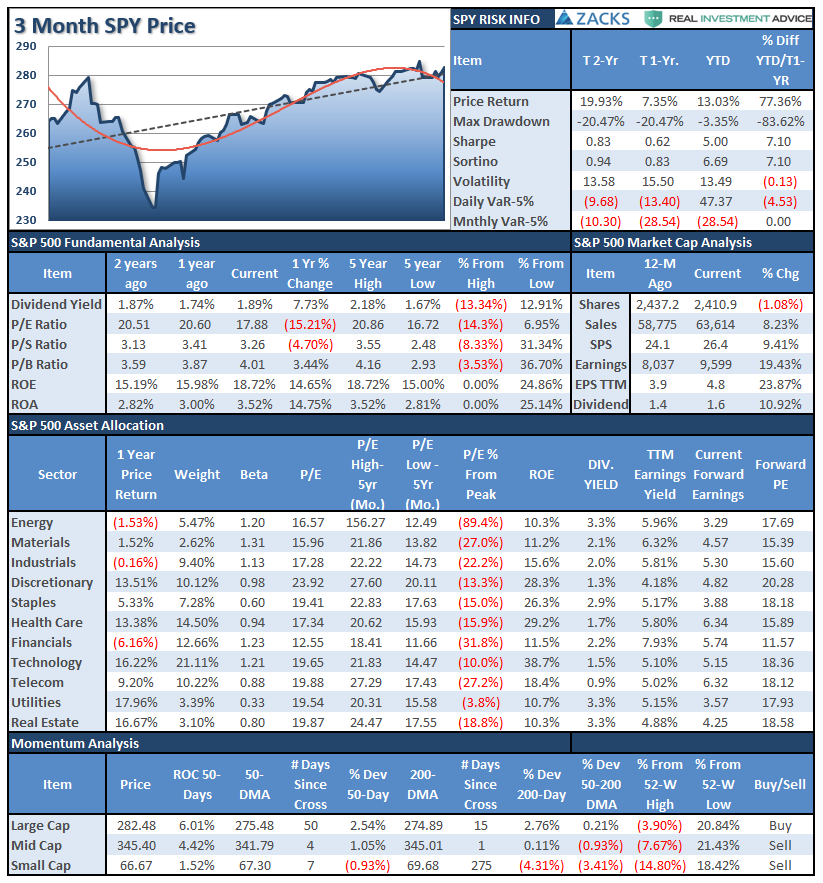
S&P 500 Tear Sheet
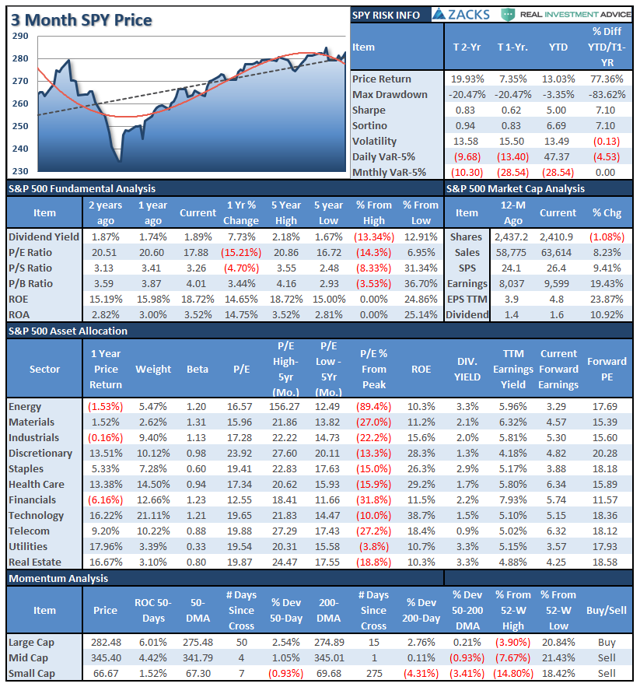
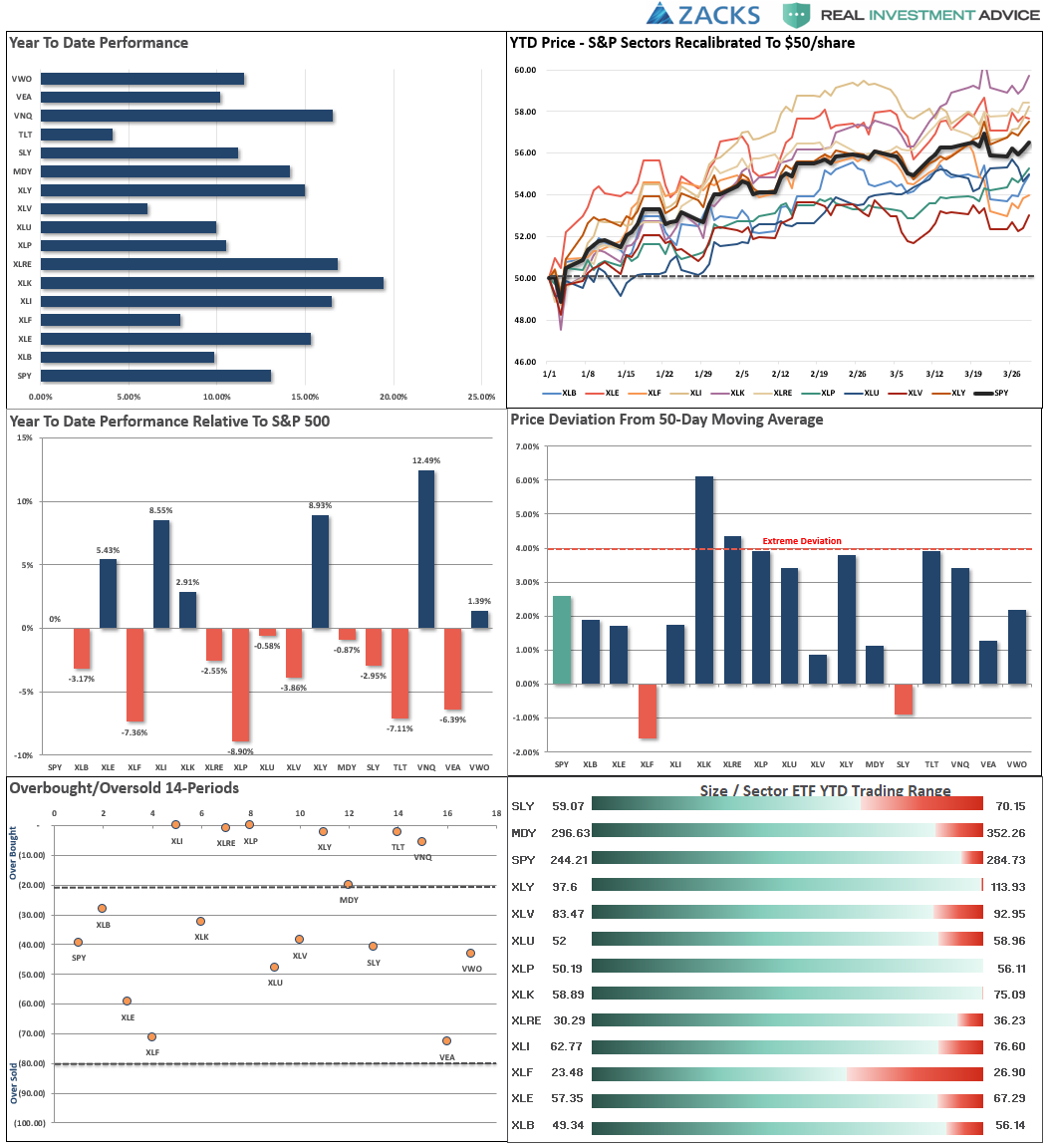
Performance Analysis
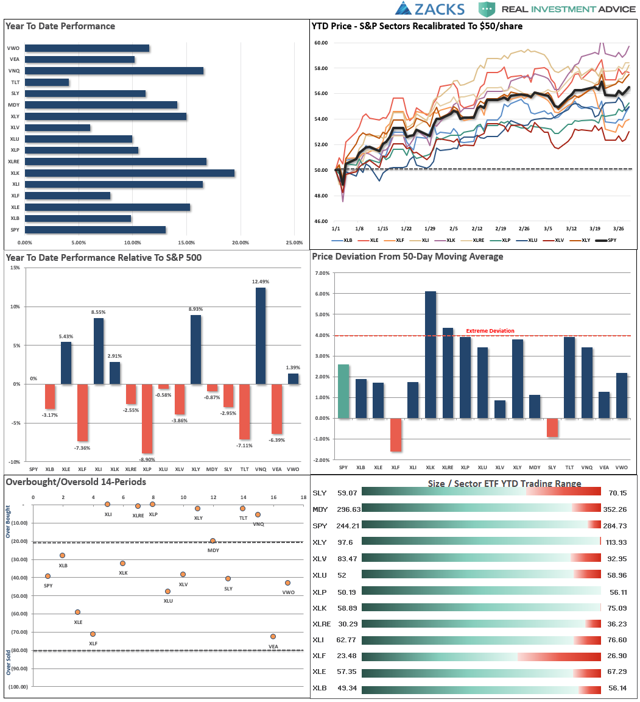
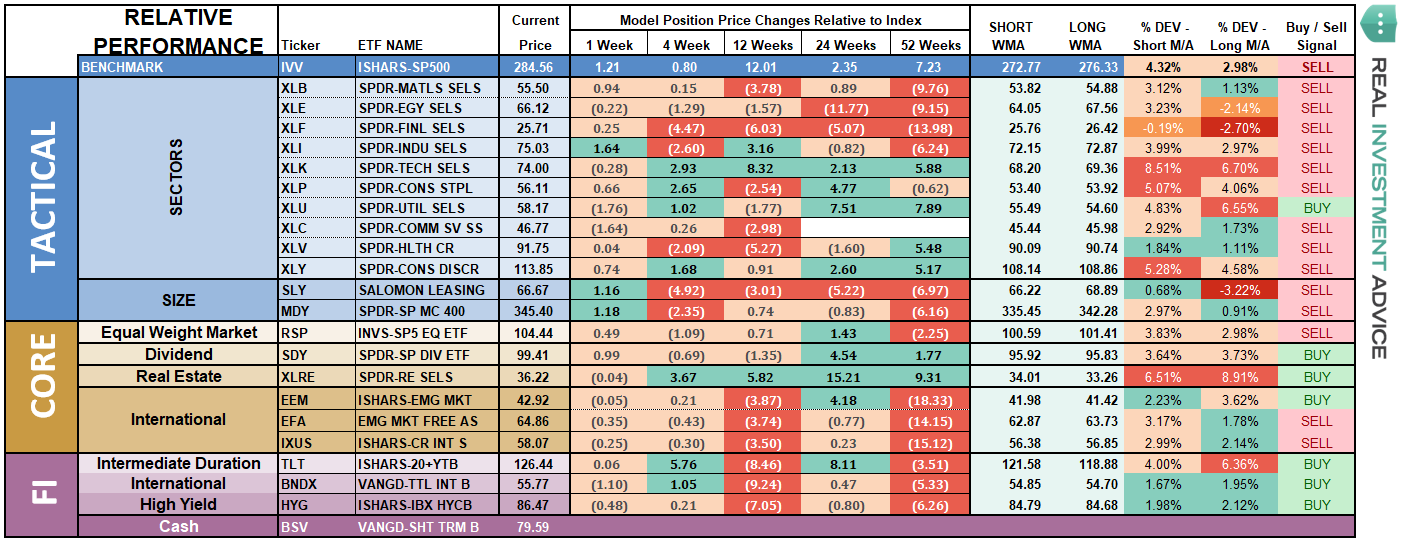
ETF Model Relative Performance Analysis
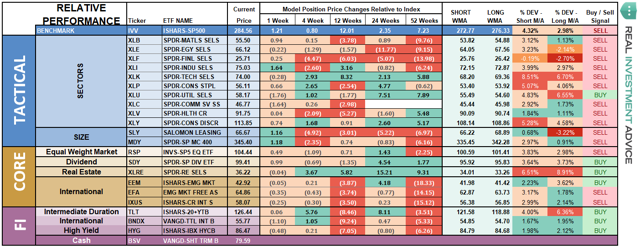
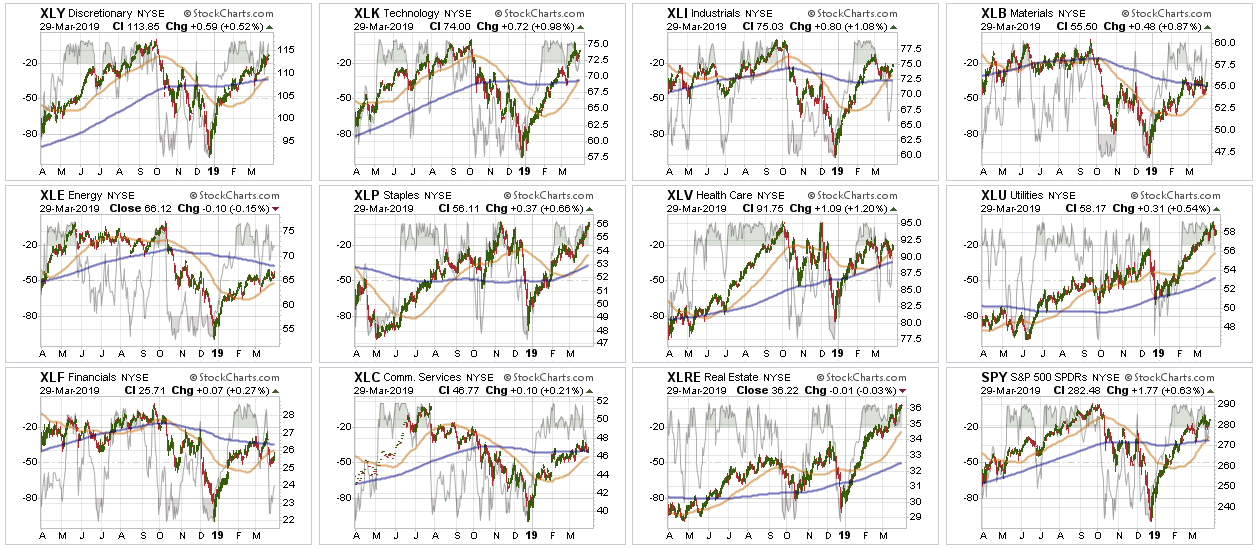
Sector & Market Analysis:

Be sure and catch our updates on Major Markets (Monday) and Major Sectors (Tuesday) with updated buy/stop/sell levels

Sector-by-Sector
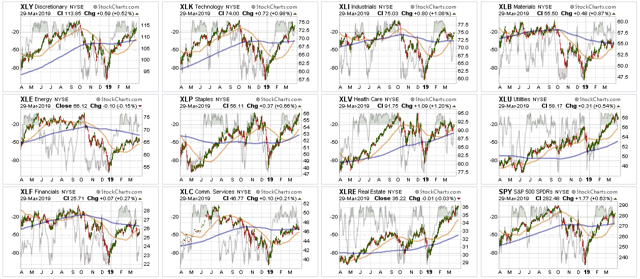
Looking at sectors on a “relative performance” basis to the S&P 500, we have seen some rotations in leadership over the last week.

Improving – Energy

Energy began to improve its performance as oil prices perked back up last week. With oil back to the higher end of its trend range, this is likely a good time to harvest some profits from the sector.

Current Positions: 1/2 Position in XLE

Outperforming – Technology, Industrials, Discretionary & Communications

Discretionary particularly picked up performance last week and joined the small group of sectors where the 50-dma has crossed bullishly. Industrials also gained ground on continued hopes for a trade resolution with China. These sectors are all overbought, so take some profits, but remain long for now.

Current Positions: [[XLI]], XLY, XLC, XLK – Stops moved from 50- to 200-dmas.

Weakening – Real Estate & Utilities

Lately, Utilities and Real Estate have been on a parabolic advance. Not surprisingly, they are taking a breather as money rotated to more offensive sectors last week. We have previously recommended taking profits in these sectors for now, which remains the advice again this week.

Current Position: [[XLU]]

Lagging – Healthcare, Staples, Financials & Basic Materials

Financials have been struggling as of late due to the inversion of the yield curve which impacts their profitability. Healthcare and Staples also weakened a bit this past week as money rotated from defense to offense in the market. Take profits and reduce back to portfolio weight as needed.

Current Positions: [[XLB]], XLF, XLV, XLP – Stops remain at 50-dmas.

Market By Market
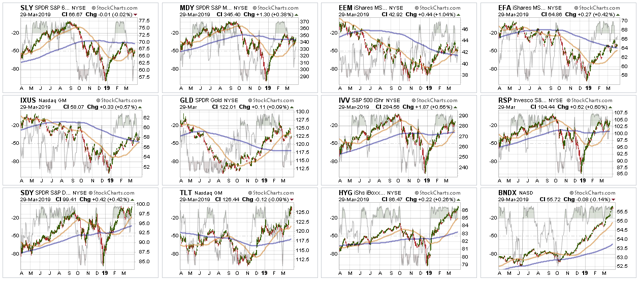
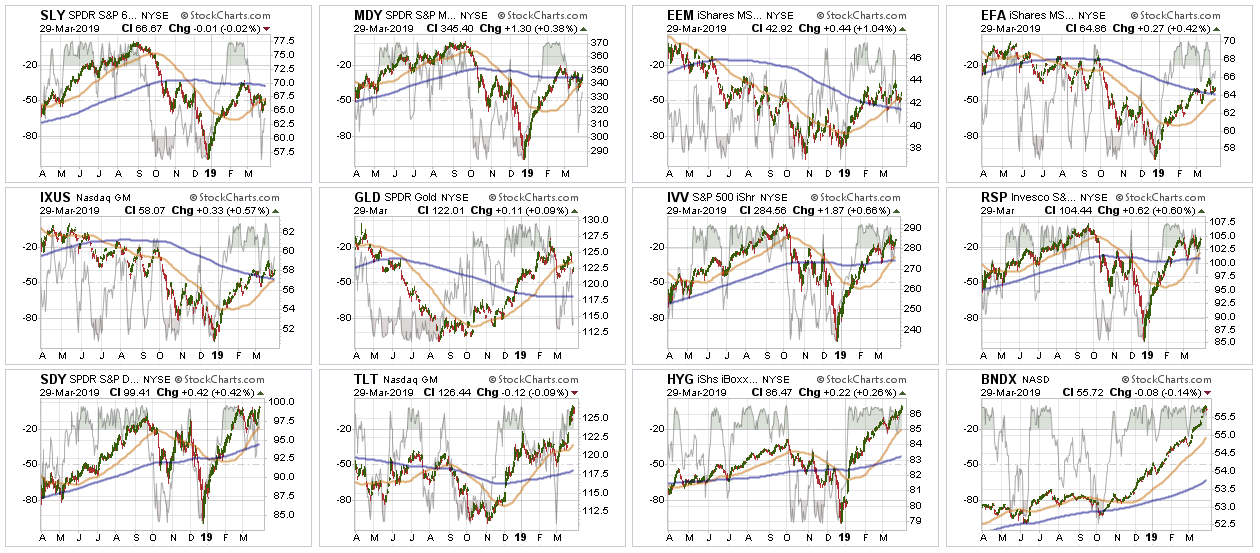
Small-Cap and Mid Cap – Both of these markets remain confined within the context of a broader downtrend. As we have noted over the last several weeks, these two sectors are more exposed to global economic weakness than their large-cap brethren so caution is advised. Take profits and reduce weightings on any rally next week until the backdrop begins to improve.

Current Position: None

Emerging, International & Total International Markets

As noted last week, Emerging Markets pulled back to its 200-dma after breaking above that resistance. We did add 1/2 position in EEM to portfolios three weeks ago understanding that in the short term, emerging markets were extremely overbought and likely to correct a bit. That corrective action is continuing and we need a breakout above the current consolidation to become more aggressive on the holding.

Major International & Total International shares DID finally break above their respective 200-dmas on hope the worst of the global economic slowdown is now behind them. The pullback last week has brought the market back to test its 200-dma. It is critical that support holds next week. Keep stops tight on existing positions, but no rush here to add new exposure.

Stops should remain tight at the running 50-dma which is also previous support.

Current Position: 1/2 position in EEM

Dividends, Market, and Equal Weight – These positions are our long-term “core” positions for the portfolio given that over the long term, markets do rise with respect to economic growth and inflation. Currently, the short-term bullish trend is positive and our core positions are providing the “base” around which we overweight/underweight our allocations based on our outlook.

Core holdings are currently at target portfolio weights.

Current Position: [[RSP]], VYM, IVV

Gold – Despite the reversal of the Fed, the collapse of the yield curve, and concerns about global economic growth, gold sold off last week and broke the rising trend of the 50-dma. Gold is oversold currently, but has really struggled to advance. There isn’t a compelling reason to add more to our holdings at this juncture. A move above $125 will make things more interesting.

Current Position: [[GDX]] (Gold Miners), IAU (Gold)

Bonds

The big move two weeks ago was in bonds. If you have been following our recommendations of adding bonds to portfolios over the last 13 months, this portion of the portfolio has performed well in offsetting market volatility. As noted previously, intermediate duration bonds remain on a buy signal after increasing exposure last month. However, they are now extremely overbought, so look for a pullback that holds 2.50% on the 10-year Treasury to increase exposure.

Current Positions: [[DBLTX]], SHY, TFLO, GSY

High yield bonds, representative of the “risk on” chase for the markets, popped higher last week with the move higher in equities. International bonds, which are also high credit risk, are running akin to the markets. If you are long high yield or international bonds, take profits now and rebalance risk back to normal portfolio weights. The current levels are not sustainable and there will be a price decline which will offer a better entry opportunity soon.

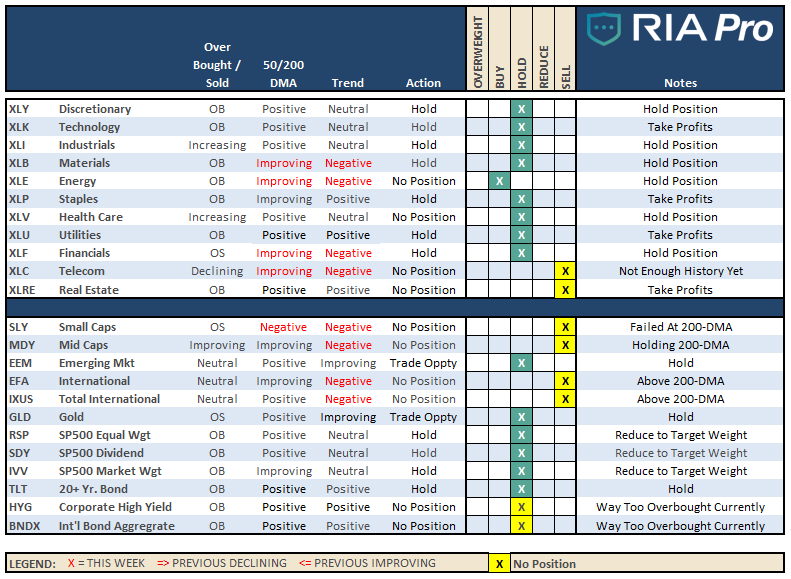
The table below shows thoughts on specific actions related to the current market environment.

(These are not recommendations or solicitations to take any action. This is for informational purposes only related to market extremes and contrarian positioning within portfolios. Use at your own risk and peril.)
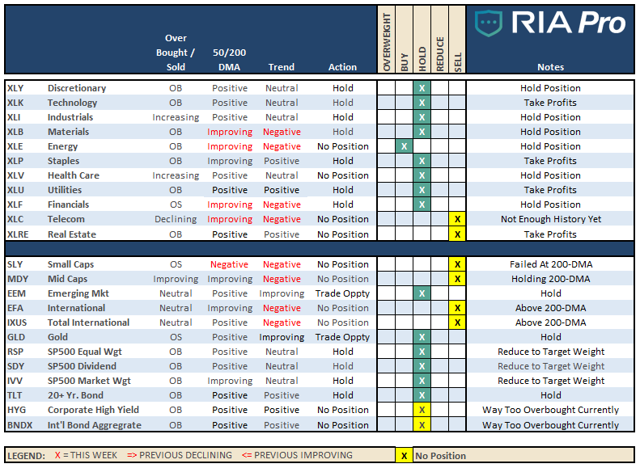
Portfolio/Client Update:

There were no changes to portfolios last week:

With rising concerns over economic weakness, the markets have consolidated over the last couple of weeks. With earnings season fast approaching, we are reviewing holdings to take profits, tighten up stops, and reduce risk.

A bad announcement or forecast can have an immediate and sharp impact on company stocks prices. However, in most cases, we are carrying underweight exposure so we may get opportunities in some of our holdings to buy at cheaper prices as long as trends are holding.

  • New clients: Will begin the onboarding process this coming week if the market continues to hold support at 2,800.
  • Equity Model: No changes – Reviewing for rebalancing as needed.
  • ETF Model: No changes. – Reviewing for rebalancing as needed.

Note for new clients:

It is important to understand that when we add to our equity allocations, ALL purchases are initially “trades” that can, and will, be closed out quickly if they fail to work as anticipated. This is why we “step” into positions initially. Once a “trade” begins to work as anticipated, it is then brought to the appropriate portfolio weight and becomes a long-term investment. We will unwind these actions either by reducing, selling, or hedging, if the market environment changes for the worse.

THE REAL 401k PLAN MANAGER

A Conservative Strategy For Long-Term Investors
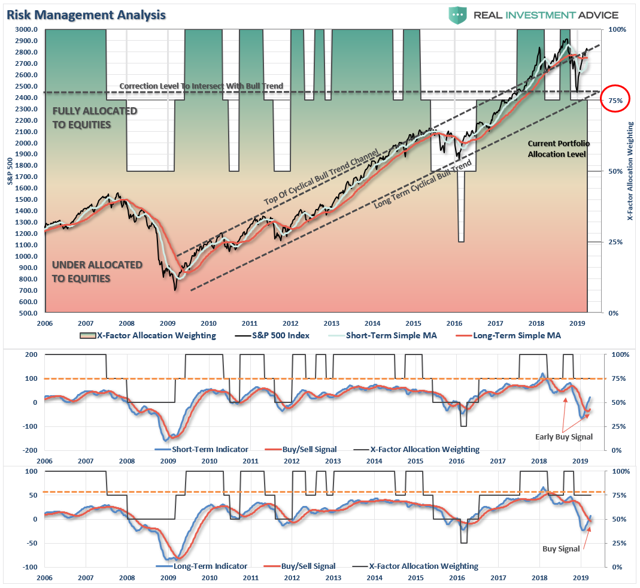
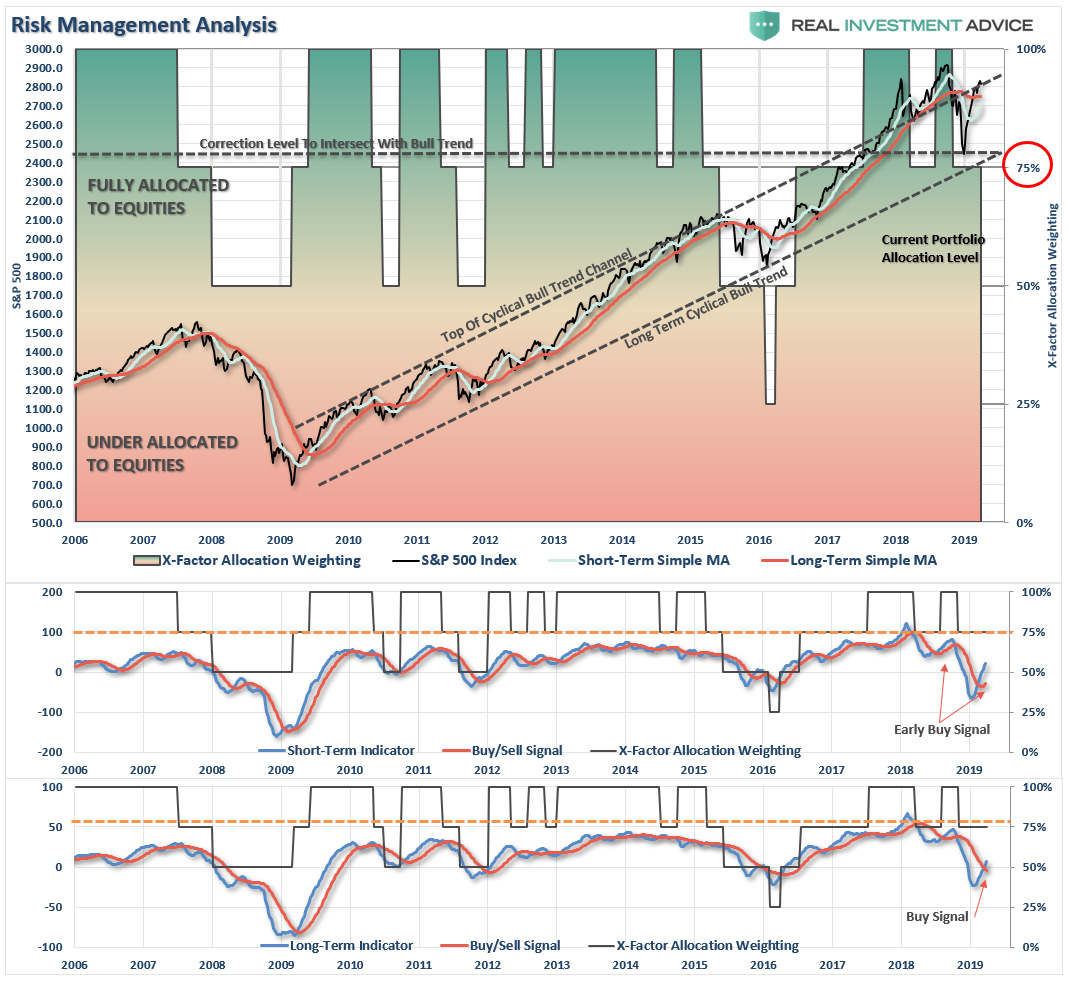
There are 4 steps to allocation changes based on 25% reduction increments. As noted in the chart above, a 100% allocation level is equal to 60% stocks. I never advocate being 100% out of the market as it is far too difficult to reverse course when the market changes from a negative to a positive trend. Emotions keep us from taking the correct action.

Rebalance To Targets

As noted above, the bullish backdrop of the market remains currently, and the recent consolidation process has alleviated some of the short-term overbought condition.

With earnings season getting ready to kick off, there is support for the markets over the next month. However, with that said, the economic risk is also rising as well, so we still want to remain cautious for the time being.

Over the last couple of months, we have repeatedly suggested to rebalance risk, align portfolios with the target, and be patient until the market gives us an all-clear sign. That advice has worked well in reducing portfolio volatility while allowing for participation to the markets.

That same advice remains this week.

  • If you are overweight equities – take some profits and reduce portfolio risk on the equity side of the allocation. However, hold the bulk of your positions for now and let them run with the market.
  • If you are underweight equities or at target – just sit tight for now and let’s see what happens next.

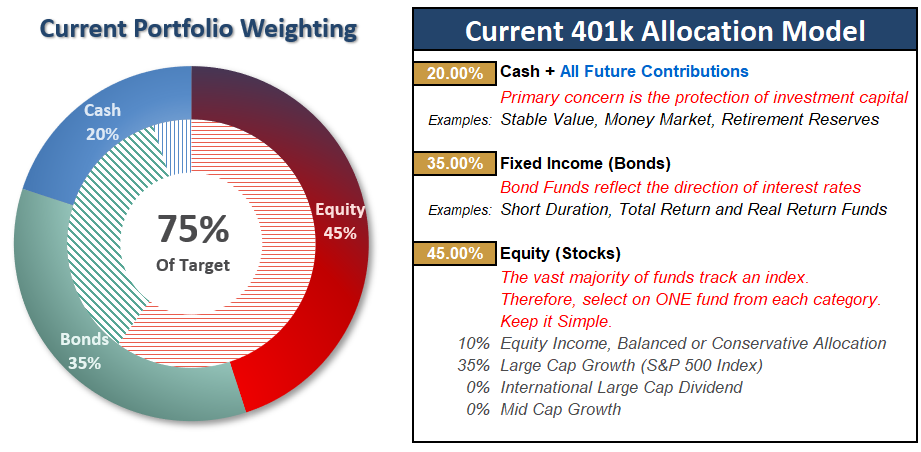
Current 401-k Allocation Model

The 401k plan allocation plan below follows the K.I.S.S. principle. By keeping the allocation extremely simplified, it allows for better control of the allocation and a closer tracking to the benchmark objective over time. (If you want to make it more complicated, you can; however, statistics show that simply adding more funds does not increase performance to any great degree.)
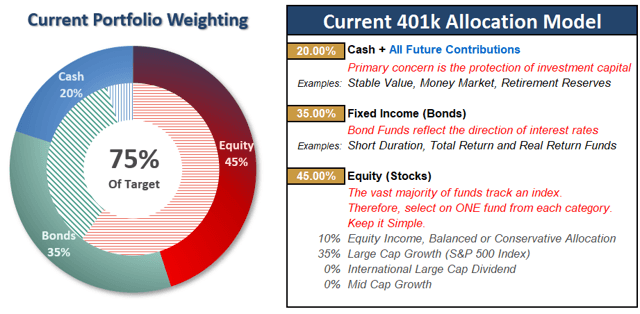
401k Choice Matching List

The list below shows sample 401k plan funds for each major category. In reality, the majority of funds all track their indices fairly closely. Therefore, if you don’t see your exact fund listed, look for a fund that is similar in nature.

Editor’s Note: The summary bullets for this article were chosen by Seeking Alpha editors.

4 Differences Between an ICO and a Penny Stock

The coins sold by small companies in Initial Coin Offerings are often compared to penny stocks. Like penny stocks, they’re cheap. Penny stocks cost less than five bucks; a new coin released at an ICO can literally cost a penny or less. They also have the potential for huge returns. Monster Beverage, a drinks company, was selling at around 60 cents a share at the start of 2005. It’s now worth nearly $60 a share. If you had bought $100 of those shares fourteen years ago, you’d now be sitting on nearly $10,000. That’s not as high as the returns earned by early Bitcoin investors but it’s still worth having. There are some important differences between penny stocks and cheap coins from ICOs though. Here are four of them:

  1. An ICO Doesn’t Give You a Company

Penny stocks might be cheap but they’re still stocks. They give you a share of a company, possibly with voting rights. An ICO only releases a product whose value you hope will rise. It’s like a new casino raising funds by selling its unique poker chips cheaply. If the casino is popular those chips could be worth a lot of money. But if the casino is never built, you’ll be left with a pile of useless discs.

  1. You Can Research the People Behind the ICO

One reason that a penny stock is such a high risk is that there’s often very little information about the company or the people behind it. You might not know who the managers are, what they did before they launched the company or whether they’re serious. You might know no more than the price of the stock and the name of the business. The rest is a shot in the dark.

Before launching an ICO, cryptocurrency firms release white papers. Those white papers will explain the background of the people launching the firm. You can often contact them on Telegram and ask them questions. That doesn’t mean that you can find all the information you want, or always get the answers you need. There will always be gaps and risks. But ICOs can provide details about the people behind them.

  1. You Can Research the Business Idea

The white paper should also explain what the company is doing and how it plans to do it. Again, that doesn’t mean that the company will actually do what it says. It doesn’t mean that the managers have the skill or the competence to do what they intend. But you should be able to assess their idea and decide for yourself whether or not you think it has legs. A bet on an ICO is a bet on a business idea.

  1. Coins Are Easier to Buy and Sell than Penny Stocks

Penny stocks are usually bought and sold through brokers. The markets are illiquid, the commissions are high and the process isn’t straightforward. The products of ICOs aren’t always sold on major cryptocurrency exchanges but you can usually buy them directly from the companies and if the coin is a success, you can expect it to be listed in the future.

“Easier” isn’t the same as “easy” though. Trading volumes will still be small. Not all coins will be listed on an exchange and those that are listed, often find themselves on small exchanges.

Like penny stocks, buying a small coin at an ICO is a high risk venture. But you can keep your losses low, and who knows, you might just strike it big!

Published on: Mar 31, 2019

Leaky Databases Are a Scourge. MongoDB Is Doing Something About It

MongoDB, a database software provider whose stock has been on a tear recently, just hired its first-ever chief information security officer. The appointment, which came Friday, signals that the company plans to take security more seriously even as it faces stiffened competition from the likes of Amazon and other tech giants.

The new boss is Lena Smart, a Glaswegian cybersecurity professional. Smart formerly held the same title at IPO-bound Tradeweb, a financial services firm that supplies the technology behind certain electronic trading markets. Prior to Tradeweb, she headed security at the New York Power Authority, where she worked for more than a decade. A cellist in her spare time, Smart told me in her Scottish brogue that her priority in the new job will be “knowing what the crown jewels are—that’s our customer data—and making sure that’s always protected.”

People leaving MongoDB and other databases unsecured on the web has been a persistent source of data-leaks over the years. Just this month, a security researcher discovered one such sieve that exposed to public view a trove of sensitive information, including location data, on millions of people in China. The misconfigured repository appears to have originated from SenseNets, a Shenzhen-based company that is likely providing the Chinese government with crowd-surveilling, facial recognition technology to track the country’s muslim Uyghur population. This is just the latest leak example; there are innumerable others.

Despite the frequency of these leaks, the situation seems to be improving. Most of these inadvertent leaks have sprung, in fairness, from people using outdated instances of the company’s so-called community edition software, a free, barer-bones version of the database product. Mark Wheeler, a MongoDB spokesperson, conceded that the 12-year-old company “struggled in its early years to find the right balance with security.” But he avers that updates to the default settings of MongoDB’s software over the past few years, plus key security team hires—including guardians Davi Ottenheimer, Kenn White, and now Smart—are changing the equation.

As Smart’s scope involves securing the totality of MongoDB’s business, the data-spillage issue ultimately falls to her. She says she’ll continue educating customers in best practices when it comes to security. She says she will also aim to imbue the company’s product development process with security, quality assurance, and testing from the earliest stages. “If we can get in at the very start” of the software development lifecycle, Smart says, it will “save us time and money and make our products more reliable and secure.”

The leaky database issue is one that extends well beyond MongoDB. It’s also a problem for rivals such as Amazon, particularly its S3 buckets, Elastic, and others. Like so many companies, these database-makers are looking now to shore up their software in the hopes of turning a historical weakness—cybersecurity—into a competitive strength. As Dev Ittycheria, MongoDB’s president and CEO, tells Fortune: making the company’s products as secure as possible “is critical to our business.”

Indeed, it’s critical to MongoDB and, increasingly, every business.

A version of this article first appeared in Cyber Saturday, the weekend edition of Fortune’s tech newsletter Data Sheet. Sign up here.